AURETHIS
Long stable period of warm orange-gold light. Peak biological activity. Convergence sessions open. The Renewal begins here.
Transitional buildup. Magnetic activity increases. UV output climbs. Flora begins contracting. Fronds retract.
Peak intensity. Blue-white UV shift. Entire Seraphim civilization enters dormancy. Convergence in constitutional recess.
Amber light returns. Lattice reactivates slowly. Renewal window opens. The most sincere commitments a Seraphim can make.
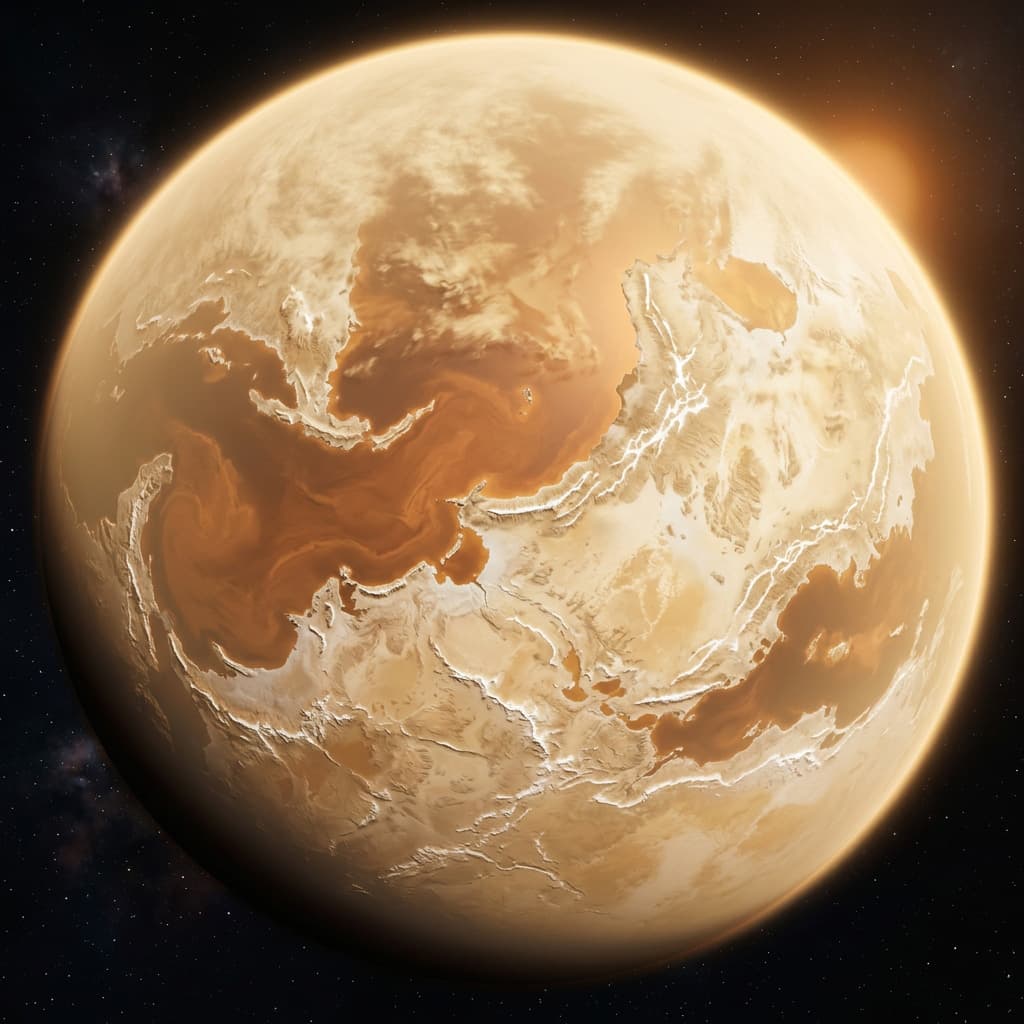
Aurethis is the homeworld of the Seraphim, orbiting Orvael — a magnetically active K-type variable star whose cyclical spectrum shift governs every significant aspect of life on the planet. It is a large terrestrial world, 1.23 times Earth's radius, with a photonically saturated surface environment unlike anything else in the surveyed catalogue. Light here is not ambient background. It is the organizing principle of the biosphere.
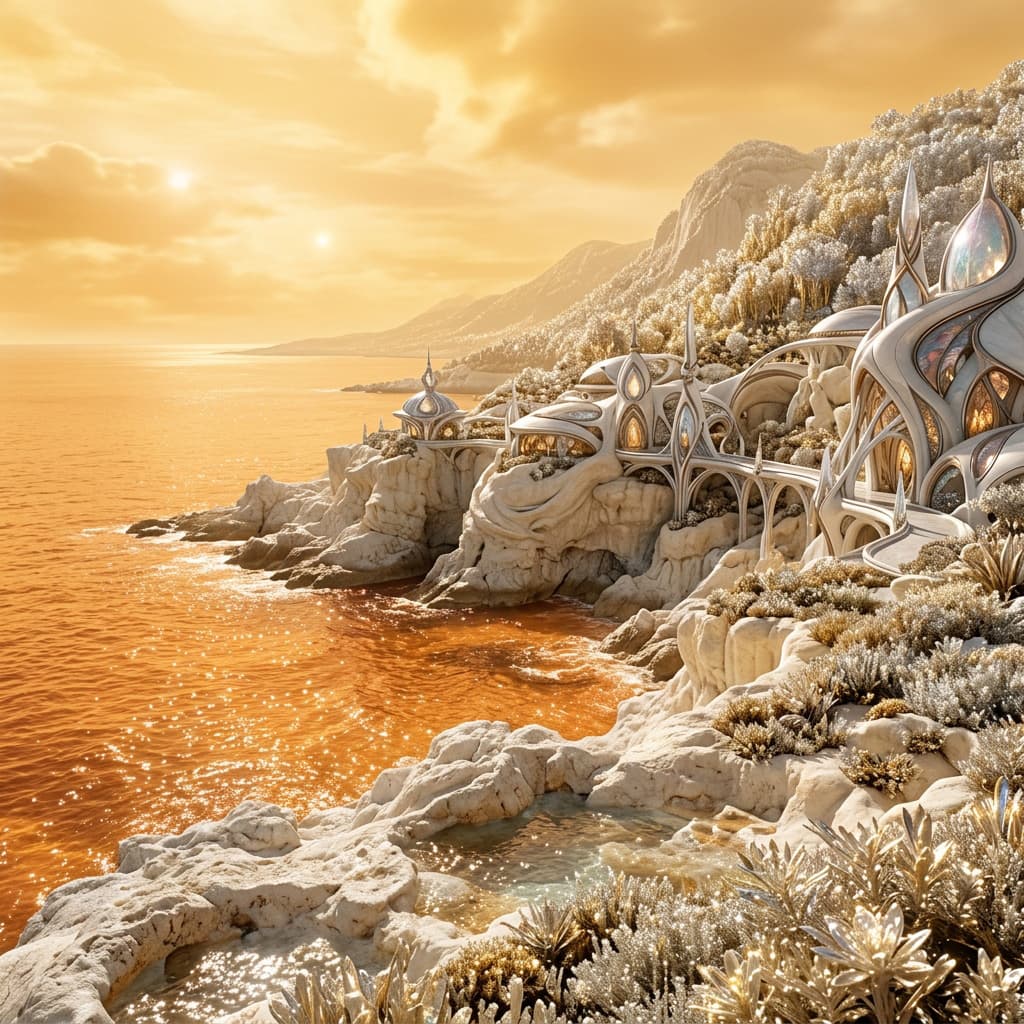
Orvael's output, diffused through a reflective particulate atmosphere, produces a pervasive golden saturation across the surface — not the directional sunlight of Earth but something that seems to arrive from everywhere at once, catching the metallic mineral content of the soil, refracting off the copper-amber ocean surface, and rendering shadows softer and shorter than Terran intuition expects.
AXIOM interest in Aurethis is both scientific and diplomatic. The planet's variable star system, unique ocean chemistry, photonic biosphere, and the Seraphim civilization that emerged from it represent a convergence of scientifically significant properties with no direct precedent in the survey record.
“Aurethis does not feel like a world lit from above. It feels lit from within.”
Orvael is a BY Draconis-type variable K-type orange dwarf — a magnetically active star with a well-documented cyclical spectrum shift that functions as the governing clock of Aurethis's entire ecosystem. For Terran visitors, it appears significantly larger in the sky than Sol does from Earth, with a deep orange-gold color during the Amber Phase that shifts noticeably toward white-blue as the Rising progresses.
Orvael's K-type classification places its luminosity well below Sol, which is precisely what makes Aurethis habitable despite its close orbital position. The Flare Crown elevates UV meaningfully but does not produce extreme thermal loading — the primary hazard during peak phase is radiation rather than heat.
Aurethis's atmosphere is nitrogen-oxygen in the standard breathable range, with surface pressure slightly above Terran baseline. The most notable property is elevated mineral particulates in suspension — a persistent upper atmosphere feature giving the sky its amber-gold tone and functioning as both UV diffuser and thermal buffer. The particulate profile is non-toxic to Terran respiratory biology.
Terran personnel must remain in shielded environments or use full UV protection during Flare Crown peak. Surface operations on Aurethis are typically scheduled around the Amber Phase window. Seraphim installations include standard Flare Crown shelter provisions.
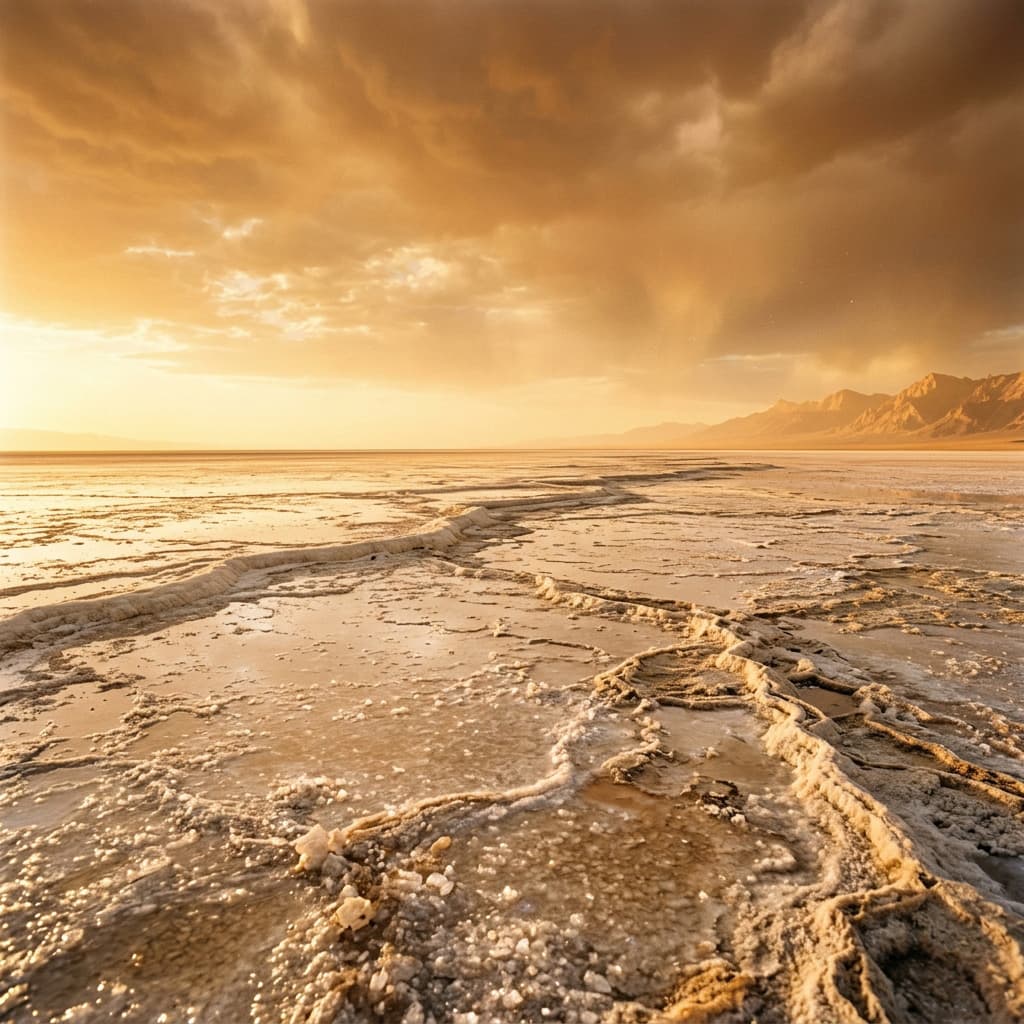
Aurethis has approximately 40% ocean coverage — meaningfully less than Earth, and declining over geological time. The mineral flats that cover significant portions of the landmasses are ancient seabeds. The ocean once covered more of the planet than it does today — but it is not retreating at any rate perceptible to any civilization.
Most complex terrain. Chemically rich, photonically varied. Calcium carbonate formations ring the coastlines. Largest Seraphim population centers. Oldest continuously inhabited settlements.
Higher silica concentration, fractured irregular terrain. Densest flora growth. Most biologically productive on the planet. Orvathi tradition heartland. Visually dramatic under Amber Phase light.
Ancient exposed seabeds, crystallized under long Orvael exposure. Intensely reflective. Calcium carbonate ridges mark old shorelines. Drevhari territory. Operational hazard for unprotected Terran visitors.
Aurethis's biosphere evolved under conditions of photonic abundance rather than scarcity. The primary evolutionary pressure across most lineages was managing excess stellar energy — developing systems to regulate, store, and utilize the constant high-output of Orvael without being damaged by it.
Where Earth's plant life evolved dark pigmentation to maximize light absorption, Aurethis flora evolved reflective and refractive surfaces to control how much energy actually reaches the photosynthetic machinery buried beneath. The result is a biosphere that appears, at first impression, to be made of different materials than Terran life — more mineral, more crystalline, more capable of catching and redirecting light rather than simply absorbing it.
“The primary evolutionary pressure was managing excess stellar energy — not competing for limited light.”
The Dimming is the single most significant selective pressure in the evolutionary history of complex life on Aurethis. Every major lineage either developed a dormancy strategy or evolved the shielding required to remain active during peak UV exposure. There is no middle ground.
Aurethis flora is primarily reflective and refractive in surface structure — metallic-toned, pale, or crystalline in appearance, with photosynthetic machinery protected behind outer layers that manage incoming energy before it reaches the productive tissue. Forests in the highland zones appear silver-gold in Amber Phase light, with a shimmer that comes from reflective surface properties of the canopy rather than bioluminescence.
The impression for Terran visitors is less like a forest and more like a field of structured light.
Fronds, leaves contract inward as protective casings deploy.
Fully enclosed. Hard crystalline, resinous protective structures cover living tissue.
Casings shed. Deposited crystalline material cycles minerals back into soil.


No confirmed cross-species pathogens on record. Ingestion of untreated surface water inadvisable. Prolonged skin contact with mineral flat substrate warrants standard protective protocols. Elevated UV during Rising and Flare Crown requires optical and dermal protection for Terran personnel. Voiced fauna lattice signals are not harmful but can be disorienting on first extended exposure before calibration.
The Seraphim civilization emerged from three geographically isolated populations — coastal, highland, and interior — whose separation was maintained for most of their pre-spaceflight history by the mineral flats' impassability during the Amber Phase. Each tradition developed independently in relationship to its local environment. The planet is unified under the Convergence, but the cultural geography of Aurethis remains legible in the distribution of population, resource production, and political identity.
Aurethis from orbit is immediately distinctive: the coastal shimmer of the mineral-saturated ocean, the highland zones' silver-gold canopy visible against the paler mineral flats, and the geometric regularity of Seraphim settlement patterns. During the Flare Crown, the planet's inhabited character essentially disappears from surface observation — no movement, no light output, the Seraphim civilization as absent from the landscape as though it were an uninhabited world.
“The entire sapient population of Aurethis is dormant for the duration of the Flare Crown — and every institution that functions during that window is, by definition, operating without its principal population.”
The Convergence's constitutional session framework opens at Emergence and closes at the Rising. The Renewal — the culturally significant window when conflicts are assumed closed by default and new commitments carry particular weight — is a civilization-wide simultaneous event because the environmental trigger is planetary. For Terran personnel: any engagement that does not account for the Renewal cycle will produce suboptimal outcomes.
Flare Crown operational constraint: Any Terran presence during Flare Crown peak requires full UV shielding. Seraphim installations provide standard shelter provisions but timing constraint must be planned around.
Colonial Assembly authority drift: The Colonial Assembly's growing authority relative to the home Convergence is an internal instability worth monitoring. The off-world Renewal problem — disrupted Dimming cycles for off-world Seraphim — may affect agreement stability over time.
The Flare Crown cycle's duration — long enough to drive a sapient species into full seasonal hibernation — sits at a specific interval that shaped the entire evolutionary history of complex life on Aurethis. Whether this interval is a coincidence of stellar physics or whether the biosphere has in some feedback-mediated way adapted to a cycle that the star itself was producing before life existed is not established.
The mineral flats are ancient seabeds. The oceans are retreating. The multi-mechanism stabilization system is slowing the retreat but not stopping it. Whether Aurethis will reach a stable new equilibrium at lower ocean coverage or whether the retreat is terminal on a long enough timescale has not been resolved. The implications for long-term Seraphim civilization planning are significant.
The photonic frond appears across multiple Voiced species lineages as evidence of a common ancestor — that ancestor has not been identified in the fossil record. The frond lineage represents the only known case of a field-defined biological structure evolving naturally rather than being engineered. Understanding its origin would advance the biological physics of field-defined organisms considerably.