MARS
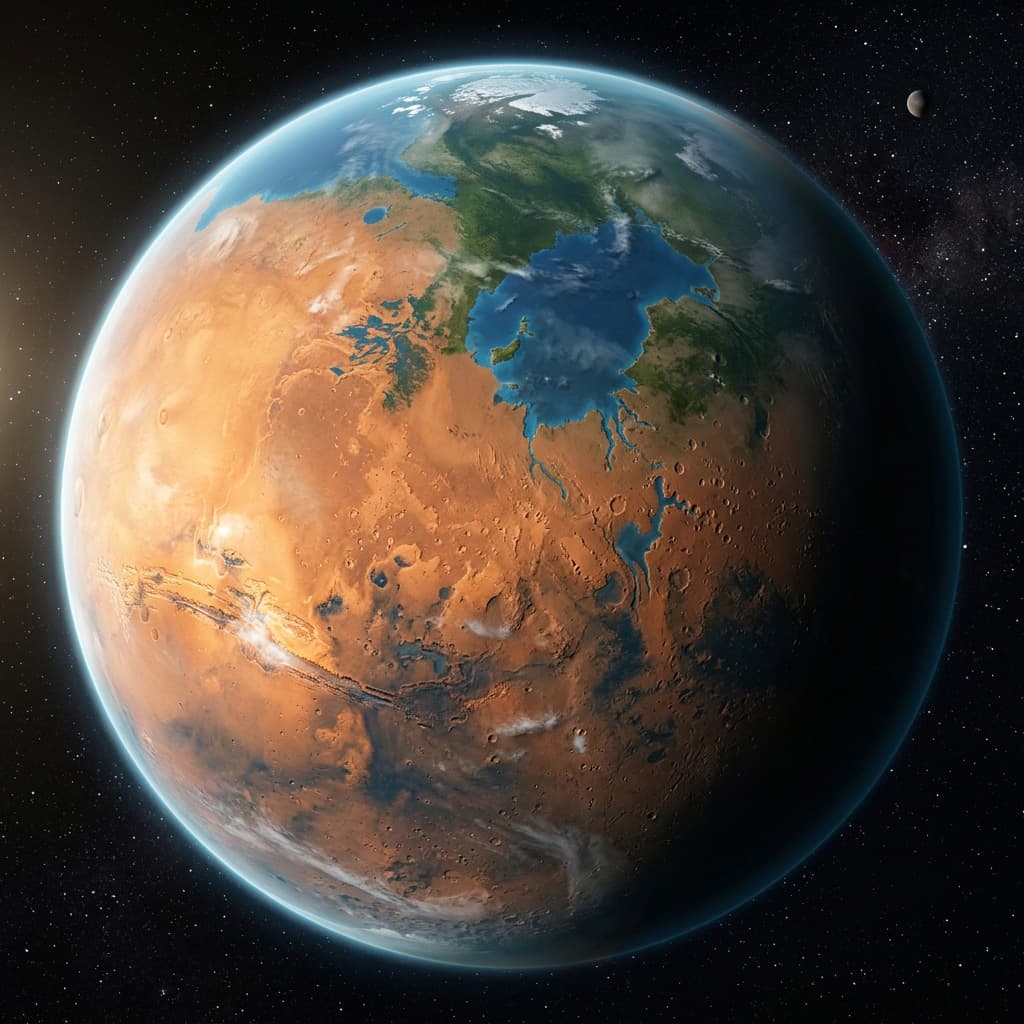
Humanity’s first terraformed world and industrial cornerstone of the United Terran Commonwealth. Four centuries of engineering determination have transformed a barren desert into the manufacturing engine of civilization. “Built Not Born.”
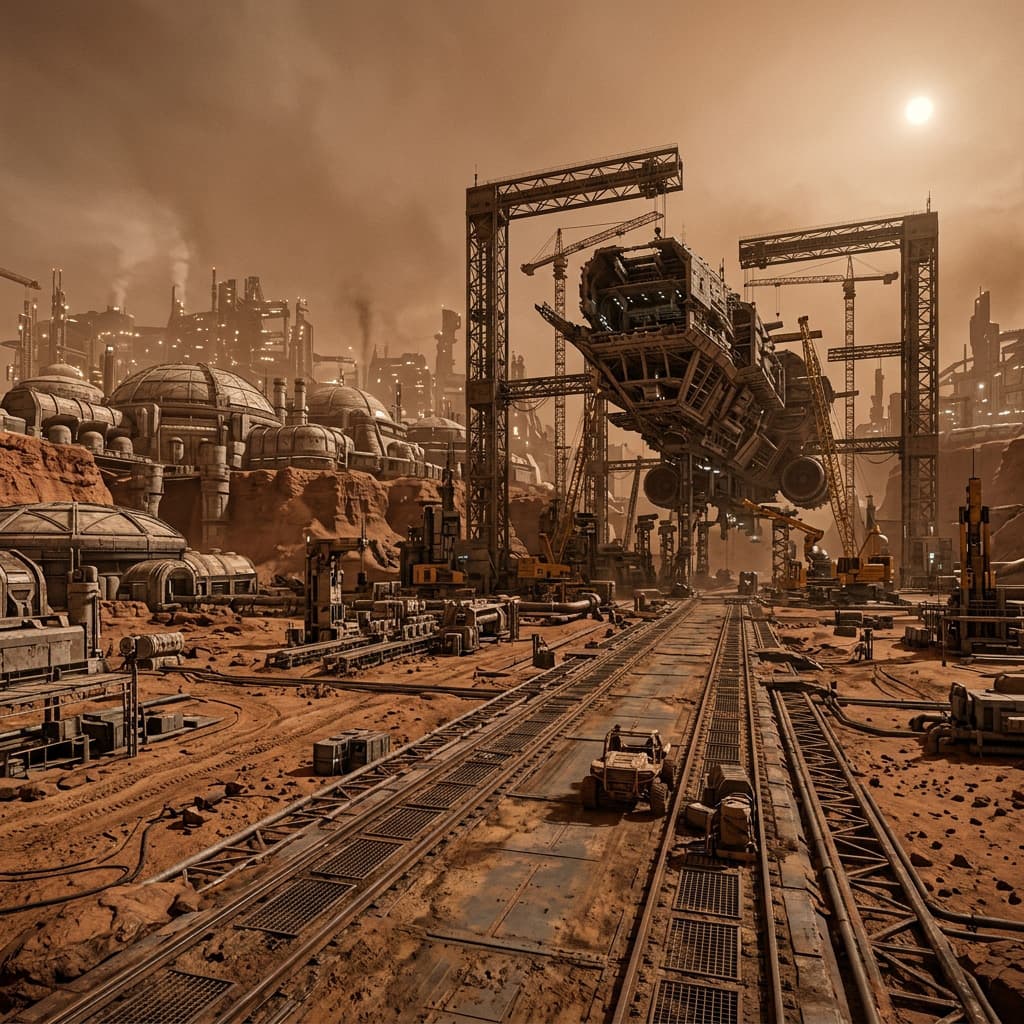
Mars is the industrial cornerstone of Terran civilization — a world transformed by centuries of persistent engineering effort from a barren desert into a functioning, if still harsh, industrial powerhouse. The planet hosts the Commonwealth’s largest modular FTL assembly yards, heavy manufacturing infrastructure, and shipbuilding facilities.
With 8.4 billion inhabitants distributed across subsurface complexes, sealed surface cities, and orbital facilities, Mars represents humanity’s first successfully terraformed planetary body and the prototype for colonization efforts across two hundred other worlds.
The planet embodies Terran determination and ingenuity. Its cultural identity centers on engineering achievement and practical innovation — the philosophy expressed in the Martian motto“Built Not Born.” Mars generates 40% of Commonwealth warp drive production and 55% of megastructure component fabrication, making it indispensable to the Commonwealth’s strategic defense and expansion capabilities.
Transit: 50,000 km planet-spanning maglev; mass drivers; orbital tethers to Phobos and Deimos; 400+ daily surface-to-orbit flights.
Energy: Fusion reactor grids; equatorial solar farms; geothermal taps into Tharsis volcanic region; He-3 imports.
Industrial Output: 40% Commonwealth warp drive production; 55% megastructure components; primary FTL assembly facilities; heavy metals processing.
Mars's shipbuilding capacity is indispensable to Commonwealth defense. Warp drive manufacturing represents a strategic chokepoint — loss of production would cripple fleet expansion. Orbital defense platforms around Phobos and Deimos protect critical assets. Surface-to-orbit interception ensures facility protection.
Mars generates unparalleled economic output through manufacturing and export. The 0.38g gravitational advantage permits economical mass acceleration through orbital facilities. Low-gravity manufacturing produces specialized materials impossible to create at higher gravity. Warp and megastructure dominance shapes Commonwealth trade policy.
Terraforming research provides foundational knowledge for campaigns across the Commonwealth. Materials science benefits from unique low-gravity manufacturing. Geological research characterizes ancient planetary evolution. Mars functions as the proving ground for colonization techniques applied on 200+ other worlds.
Can terraforming acceleration push Earth-standard atmosphere completion to 3000 CE or earlier?
Current modeling projects completion by 3100–3200 CE. Advanced greenhouse gas injection or solar reflector systems could potentially accelerate the process by a century. Early completion would benefit industrial operations, population health, and open-air colonization.
What is the maximum sustainable population given finite water and atmosphere resources?
Current population of 8.4 billion approaches estimated carrying capacity under current conditions. More precise resource modeling could determine long-term population limits and inform immigration and growth policies as terraforming advances.
Can artificial gravity generation technology reduce chronic health effects of low-gravity exposure?
Centrifuge-based facilities and rotational habitats exist but cannot scale to population-wide health management. A breakthrough in gravity manipulation technology could transform Martian habitability and reduce long-term medical costs.
Industrial complex covering portions of Olympus Mons's slopes, exploiting the volcano's elevation and gravitational advantage for component handling and assembly. Workshop caverns carved into the volcano's structure represent one of the Commonwealth's most impressive engineering achievements.
The largest FTL assembly facility in the Commonwealth, capable of simultaneous construction of multiple capital-class vessels. The complex extends underground for kilometers, with orbital launch facilities connecting to shipyard stations. Generates 40% of all warp-capable vessel construction.
Deepest integrated metallurgical complex, exploiting the Hellas Basin's profound depth for massive structural casting and processing. The facility can produce megastructure components that are impossible to create in smaller surface or orbital facilities.