THARUUNUUN
// "New Laramidia" // Convergent Biosphere //

AXIOM PLANETARY PROFILE
I. EXECUTIVE SUMMARY
Tharuun is a terrestrial world of profound scientific significance designated a Category IV Preservation World. The planet exhibits a biosphere that has undergone remarkably convergent evolutionary development with Earth's Mesozoic era—producing a world populated by giant reptiloid fauna, lower oxygen content than modern Earth but consistent with Mesozoic atmosphere, complex social behaviors, and ecological structures nearly identical to dinosaur-dominated ecosystems. Yet Tharuun's evolution occurred entirely independently of Earth, on a world isolated in unexplored space with no prior contact with Terran life.
This convergent evolution represents a paradigm-shifting discovery in xenobiology: evolutionary pressures common across Earth-like worlds produce predictable large-scale outcomes despite billions of years of independent development. The implications for understanding life's fundamental trajectory are profound.
The world is protected under Category IV Preservation protocols—no colonization, no resource extraction, no permanent settlement. Habitation remains prohibited not because the world is uninhabitable, but because its preservation for scientific study takes absolute priority.
Surface water coverage is approximately 78%, comprising shallow seas, marshlands, and freshwater basins rather than deep ocean systems. The water distribution supports the warm, humid global climate. Frequent precipitation events and high evaporation maintain sustained moisture cycles.
Tharuun exhibits standard terrestrial topography with continental landmasses, mountain ranges, lowland basins, and coastal regions. Active volcanism along continental margins creates localized hazard zones. The geological foundation supports the diverse habitats required for the complex megafauna ecosystem.
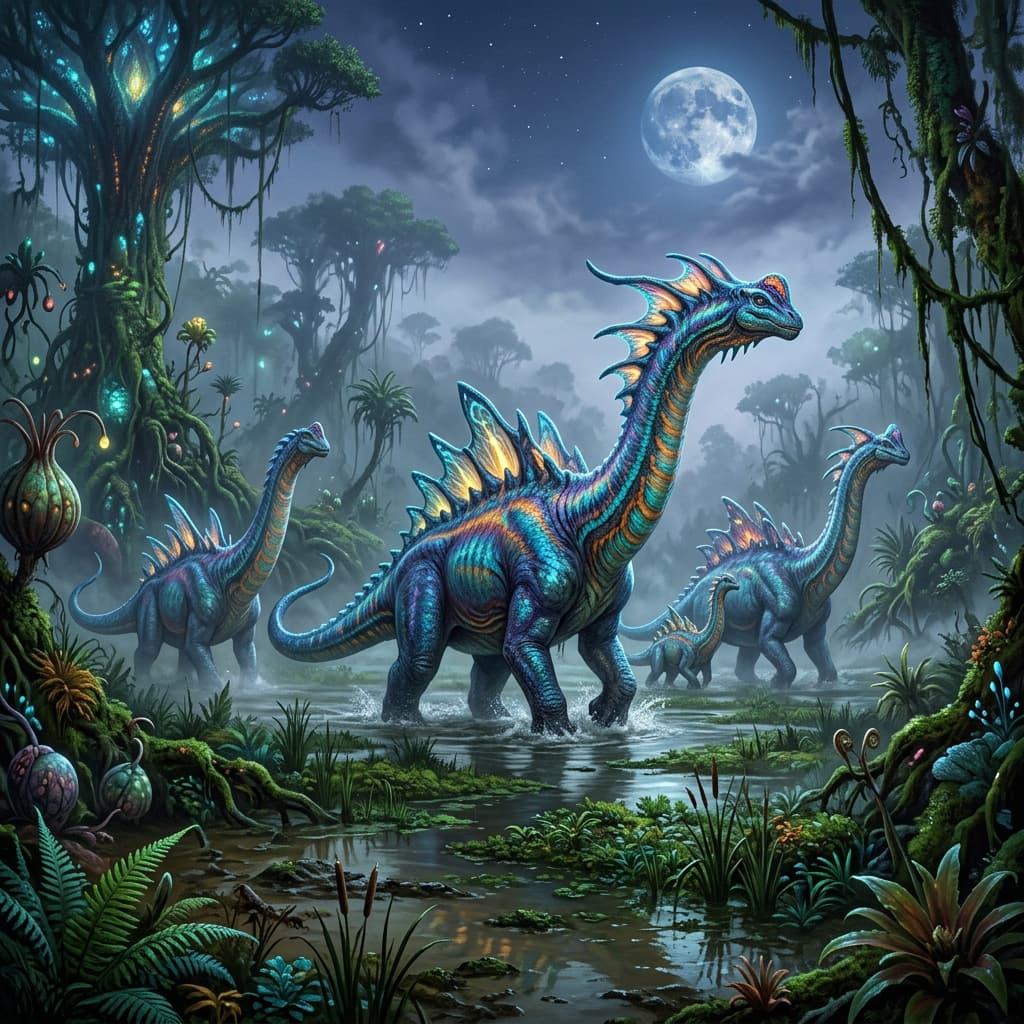
III. BIOSPHERE — CONVERGENT MEGAFAUNA ECOSYSTEM
The botanical baseline comprises broad-leafed ferns (dominant ground cover), towering pseudopines (coniferous analogs forming canopy layers), cycads (seed-bearing plants, understory), thick vine jungles (climbing and strangling plants), and marshland vegetation (aquatic and semi-aquatic specialists). The vegetation is comparable in complexity and production to Earth's Mesozoic flora.
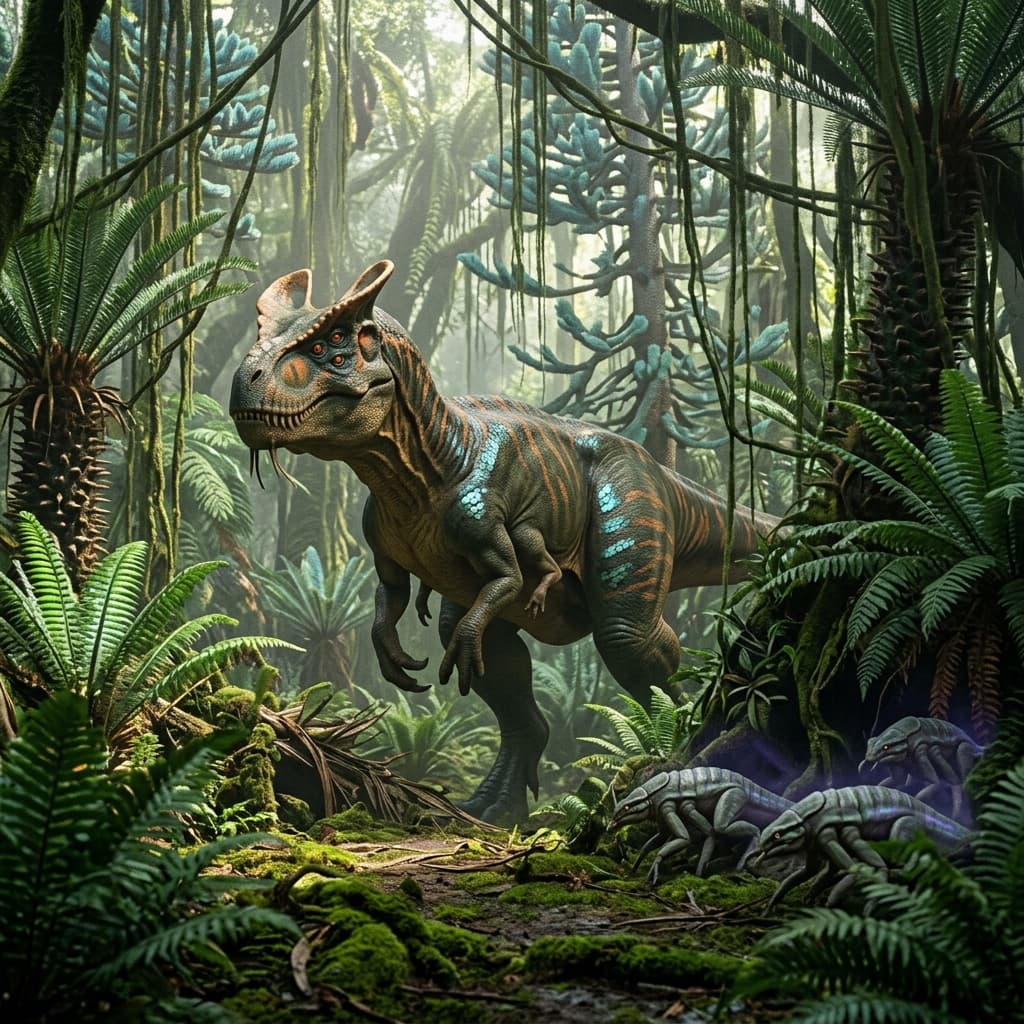
Grothar Rex
Apex bipedal predator approximately 11 meters long, comparable to Earth's Tyrannosaurus rex. Twin cranial crests function as resonance chambers, potentially for communication or threat display. Reflective scale patches facilitate temperature modulation. Estimated metabolic rate and hunting behavior suggest sophisticated predatory intelligence and pack coordination in some populations.
Aquatic Megafauna
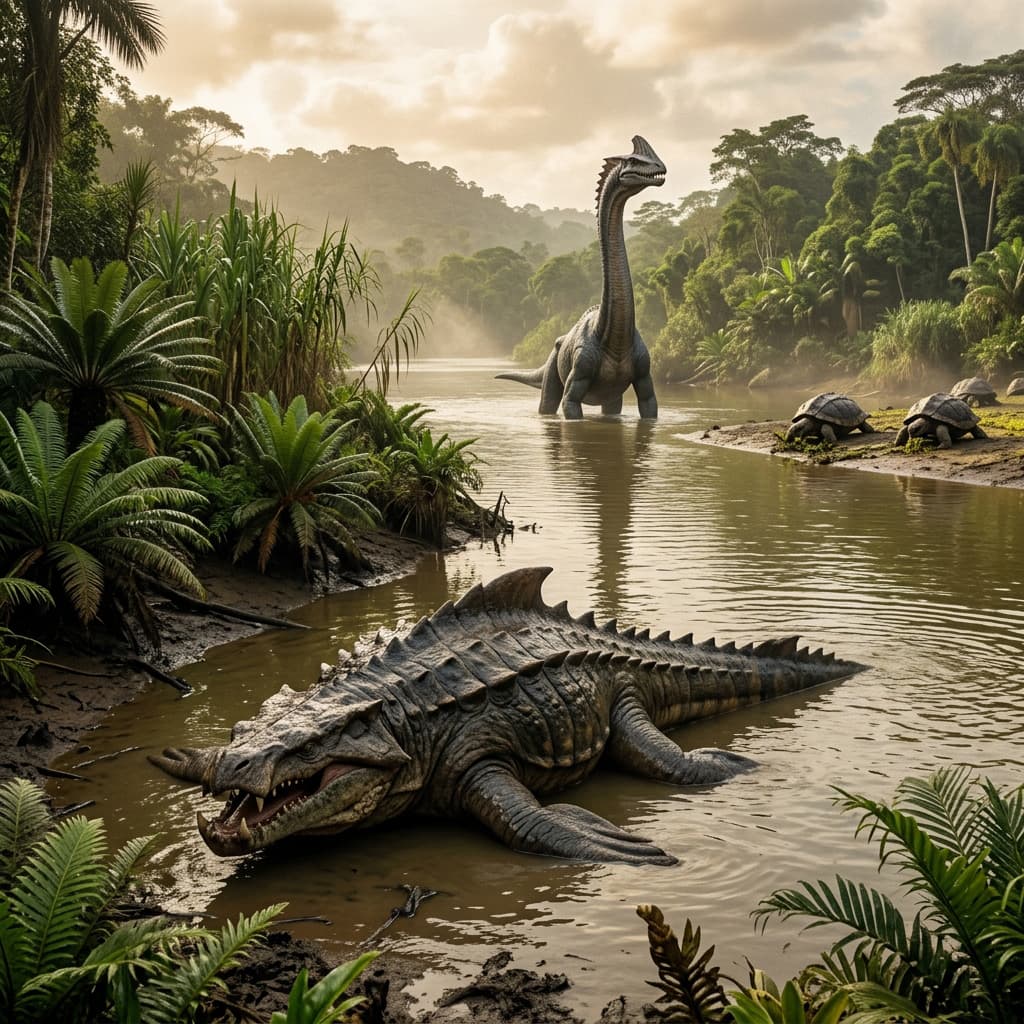
Long-bodied paddle-limbed predator inhabiting estuarine and slow-river environments. Asymmetrical bite plates specialized for armored prey. Territorial bellows communication.
Semi-aquatic piscivore with long flexible neck and crested skull ridge. Heat regulation through crest structure. Territorial display behavior.
Enormous serpentine reptile. Muscular undulation locomotion adapted to river and inland sea habitats. Possesses chemical luring organ suggesting sophisticated predatory strategy.
Fast marine hunter with elongated fin limbs, beaked snout, and translucent fin membranes with strobing communication patterns. Travels in apparent mated pairs.
Heavily armored aquatic grazer with overlapping osteo-scales, retractable tail-fan for sediment stirring, herd behavior. Forages on aquatic plants and marshroots.
Massive six-legged quadrupeds with semi-hollow cranial spines that emit deep tones for herd communication. Skin hosts symbiotic algae. Herd behavior and migratory patterns drive ecological dynamics.
Forest pack hunters with raptor-sized bodies demonstrating clear cooperative hunting tactics. Ultraviolet mating patterns suggest visual communication complexity.
Marsh ambush predators with heavy armor. Capable of burying themselves in peat for multi-day ambushes. Possess concussive jaw-snap capability sufficient to rupture tree trunks.
Aerial fishers with feathered gliding capability, elongated necks, and scale-feather hybrid wing membranes. Reflective sunlight features facilitate thermal lift. Rear-flaring tail fans for maneuverability.
| Species | Length | Earth Analog | Ecological Role |
|---|---|---|---|
| Grothar rex | ~11m | Tyrannosaurus rex | Apex predator |
| Slipcoil Leviathan | 18–22m | Marine reptiles | Deep-water apex predator |
| Malarhorn (large) | 15–18m | Diplodocus/Brachiosaurus | Large herbivore |
| Silvavek | 2–3m | Velociraptor | Pack hunter |
| Keelmaw | 8–12m | Mosasaurus | Estuarine predator |
| Cravith | 6–8m | Deinosuchus | Ambush predator |
The Tharuun biosphere exhibits full multi-level trophic complexity: primary producers (flora), primary consumers (herbivores), secondary consumers (mid-level predators), apex predators, and decomposer guilds. The food web demonstrates sophisticated energy flow patterns and ecological relationships comparable to Earth's most productive biospheres.
The megafauna exhibit complex social behaviors: herding in herbivores, pack coordination in predators, territorial display and communication behaviors, possible mating pair bonding in aquatic specialists, migratory patterns driven by seasonal resource distribution. The behavioral complexity suggests cognitive development beyond simple stimulus-response, potentially including memory, learning, and cultural transmission of hunting or herding strategies.
Standard carbon-based organic chemistry with DNA-based genetic system (convergent with Earth), water-based cellular metabolism, and protein-lipid-carbohydrate biochemistry. The convergence extends to the molecular level—life on Tharuun uses fundamentally similar chemistry to Earth life despite independent origin.
The primary hazard is the megafauna: apex predators reaching 11+ meters; territorial ambush predators capable of rupturing tree trunks; aggressive herd herbivores capable of trampling infrastructure; pack hunters with demonstrated cooperative tactics; aquatic predators present in all water bodies. Secondary hazards include elevated oxygen toxicity, extreme heat and humidity, active volcanism, and fungal growth.
Tharuun is designated uninhabited, unclaimed, and protected under Category IV Preservation protocols—the highest protection level available. Scientific observation is authorized under strict protocols; no resource extraction, no permanent settlement, and no development of any kind is permitted.
Tharuun's value is entirely scientific and resides in the convergent evolution paradigm it demonstrates. The biosphere represents the only known independent replication of Earth's Mesozoic ecosystem structure—providing unique insight into the determinism versus contingency question in evolution.
While physically habitable with life support systems, Tharuun is not a colonization candidate. The elevated oxygen and extreme heat-humidity present challenges for long-term habitation; megafauna represent constant lethal hazard; active volcanism creates unpredictable hazards. The world's scientific value as an undisturbed convergent ecosystem takes absolute priority.
The primary risks are to the biosphere's preservation: careless sampling disrupts behavioral patterns; mechanical disturbance damages ecosystem balance; atmospheric contamination can suppress spore/pollen production; accidental biological introduction poses existential threat. A secondary risk is classification error: if the convergence is not natural but engineered, the world's classification would require review at a higher clearance level.
Open Research Questions
Research Question 01
Why does Tharuun's evolution so closely parallel Earth's Mesozoic?
Whether the convergence reflects fundamental constraints on evolution under Earth-like conditions, or whether it indicates some deeper principle governing life's development across multiple worlds, remains open. Does evolution have a 'trajectory'—a general direction toward predictable outcomes—or is the Tharuun convergence a remarkable statistical coincidence?
Research Question 02
What is driving the extraordinary behavioral complexity in Tharuun megafauna?
The social behaviors, cooperative hunting, territorial displays, and apparent communication systems exceed what simple predator-prey dynamics require. The pack hunters' tactical coordination suggests memory and planning capability. Understanding what evolutionary pressures produced these behaviors could illuminate animal intelligence across species.
Research Question 03
Could Tharuun's biosphere be artificially engineered or seeded by a precursor civilization?
While the biosphere appears entirely natural, the extraordinary convergence raises the question: could an advanced civilization have deliberately engineered Tharuun's biosphere as a controlled experiment? Or seeded it with Earth-origin life? Current evidence supports natural development, but detailed genetic and molecular analysis is pending.