THECHORUS
Executive Summary
Classification note: Chorus homeworld location is AXIOM-Ω by treaty obligation and does not appear in any section of this document.
The Chorus, self-designated Sorvhen — a trans-harmonic identifier rather than a linguistic name; approximate Terran translation: "that which echoes in silence" — are one of the oldest known active civilizations, approaching one million years of continuous awareness.
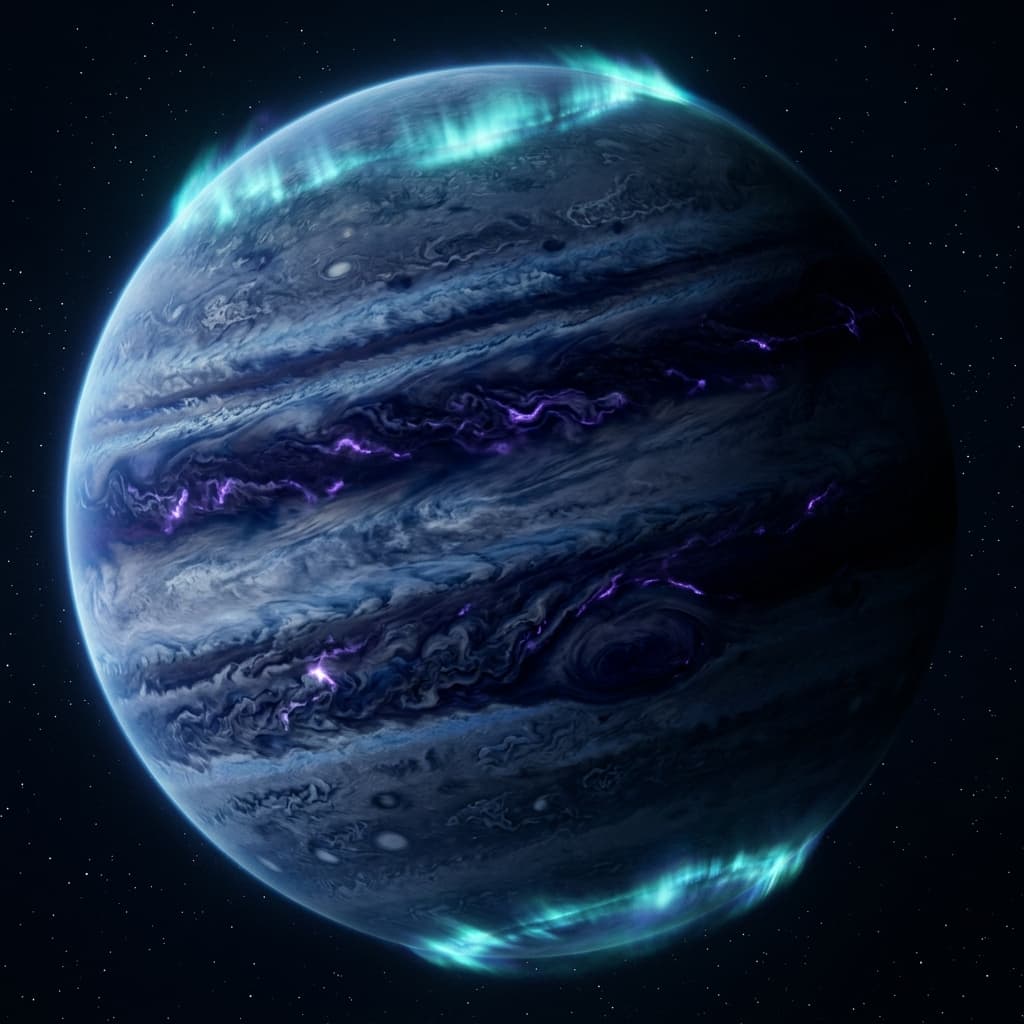
They are partially phased, distributed-consciousness entities of gas-giant origin with no technological civilization in any conventional sense. Their capabilities emerge directly from their physical and cognitive architecture rather than from constructed systems.
In current-era galactic affairs they occupy an advisory and occasional mediator role, interacting with both the Pelari Symbiotica and the United Terran Commonwealth through established diplomatic frameworks while declining active participation in political or military developments.
Biological Profile
Terran biological terminology applies to the Chorus by analogy only. What follows uses that framework as an organizational convention. The Chorus themselves do not recognize these categories, and the framework distorts as much as it clarifies.
Physical Form
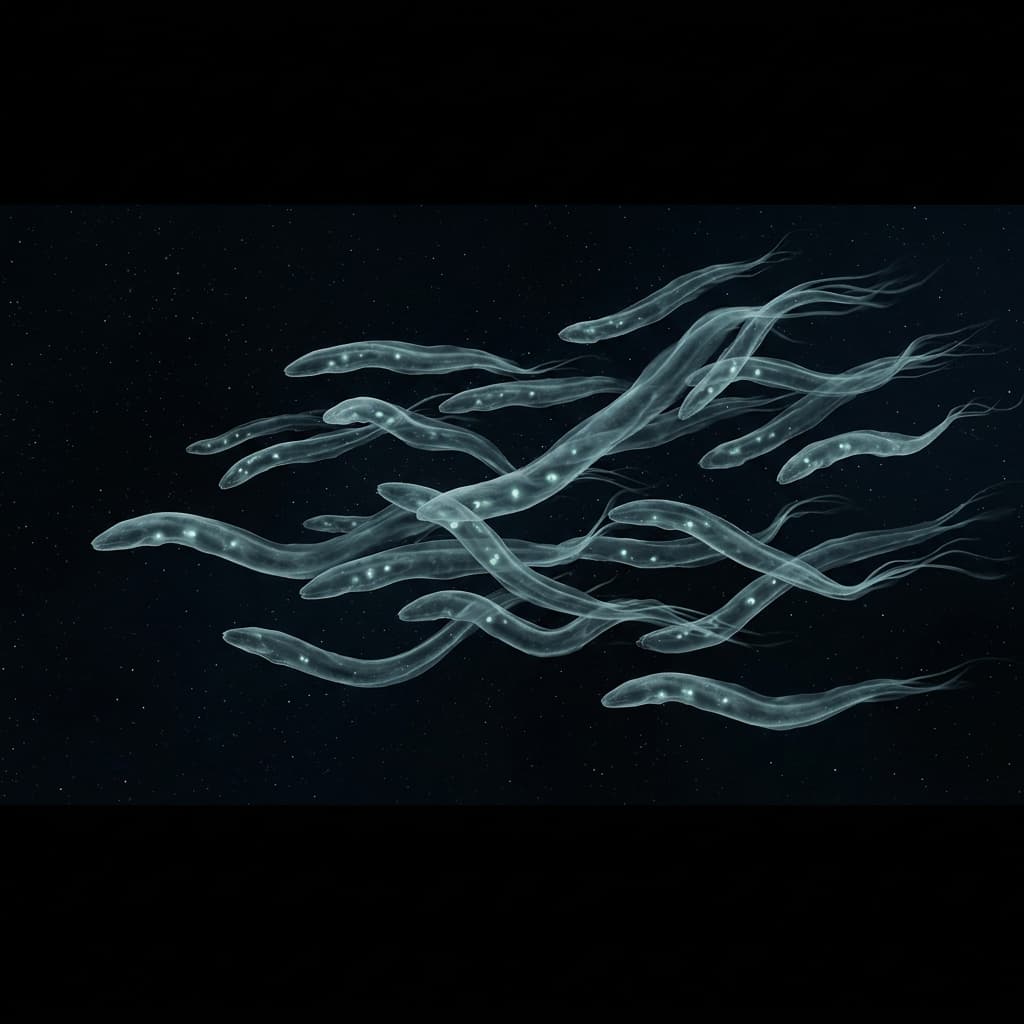
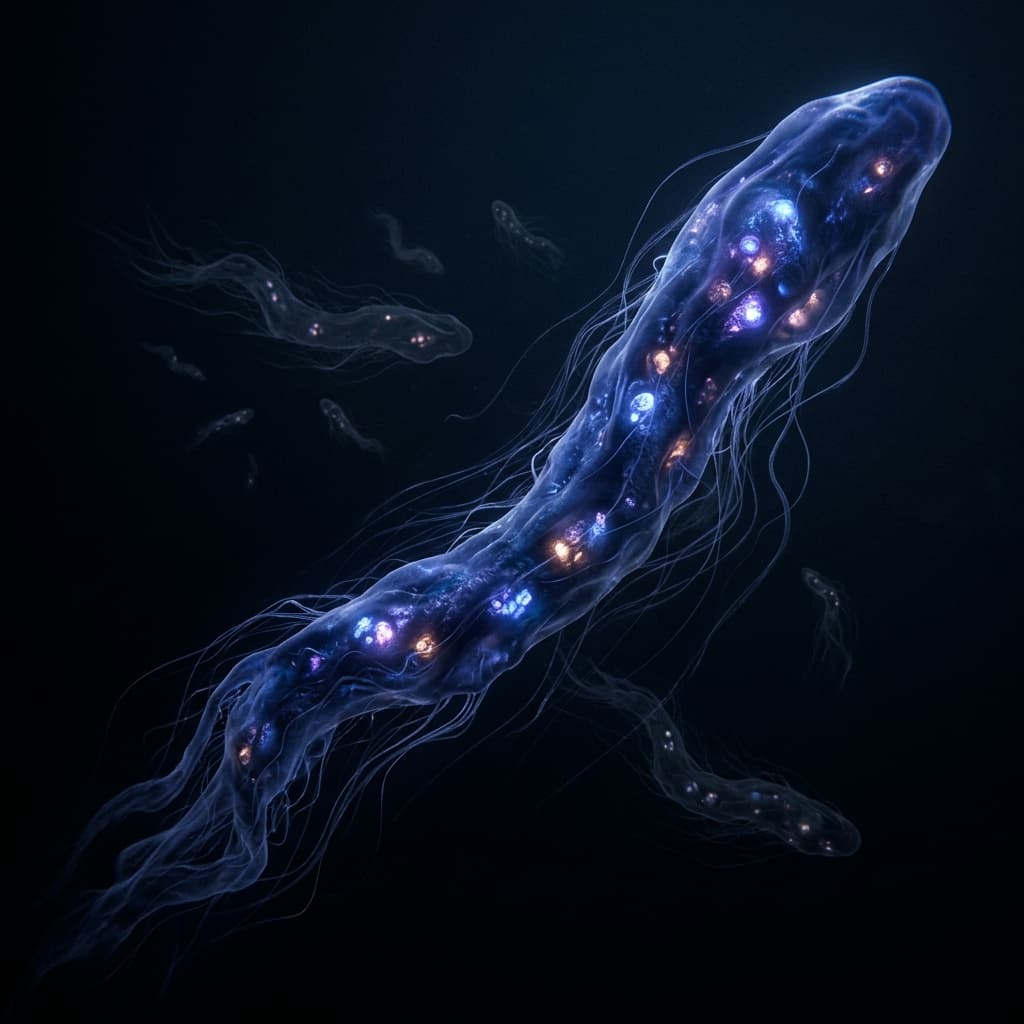
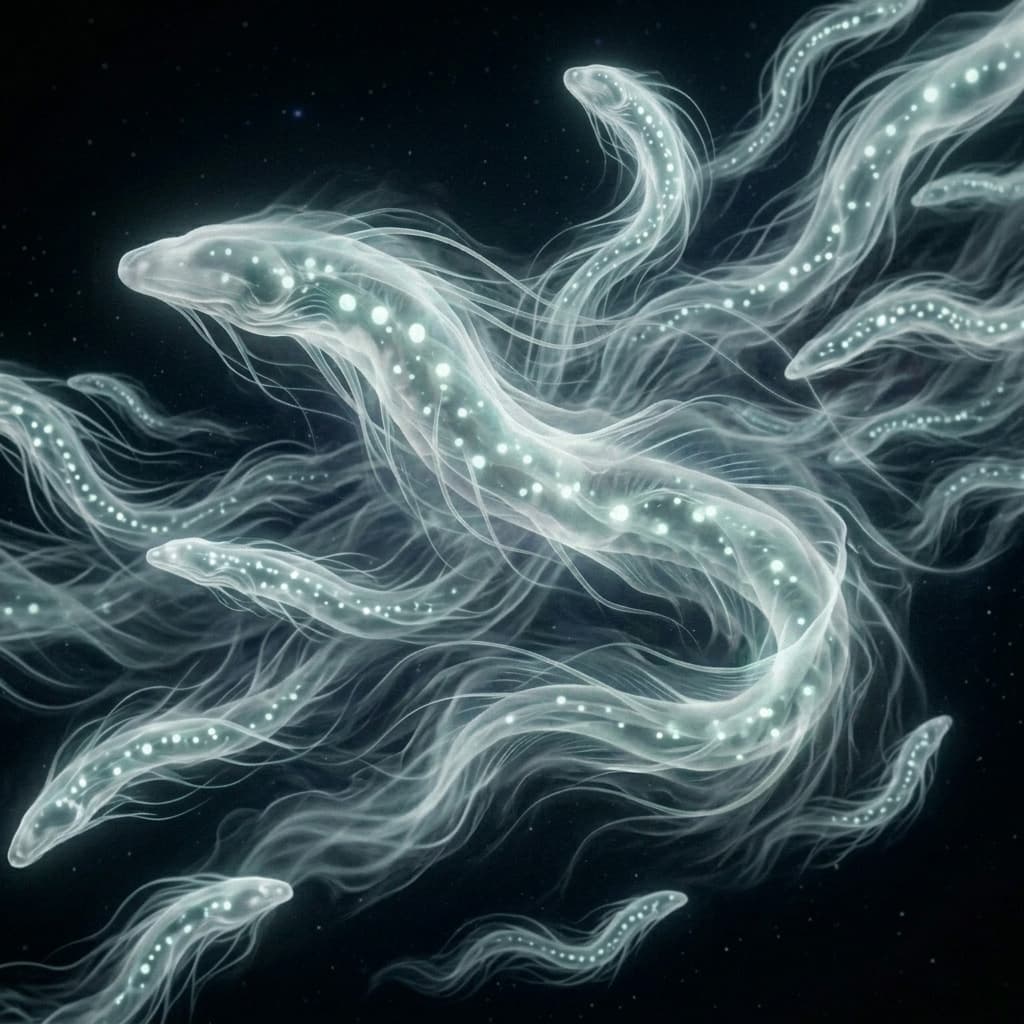
Standard Drone manifestation presents as elongated and serpentine, semi-translucent, with no fixed external boundary. The form's edges blur into surrounding space — the boundary between form and environment is not a surface but a gradient. Luminous nodules are visible within the body at irregular intervals. Trailing filaments extend from the main body mass. Coloration ranges from near-colorless to faint blue-green depending on phase density.
Phase-State Existence
The Chorus exist in a state of partial phase, simultaneously present across multiple states of matter. A Drone form at standard phase density maintains simultaneous presence across several states — solid, plasma, and the less classifiable states in between. Instruments return inconsistent readings because the form's physical extent exceeds what three-dimensional measurement can resolve.
Distributed Cognition
The Chorus operate as a distributed intelligence. No individual form holds exclusive memory or processing. All experience is continuously shared across the collective, with proximity to other forms amplifying synchronization bandwidth. No latency in synchronization has been detected at interstellar distances.
Communication Architecture
The Chorus generate oscillations of light and sound, calibrated to the receiving species through precision attention to that species' sensory and cognitive architecture. The output is impressionistic — its primary effect is the transmission of concept, intent, and emotional texture rather than discrete linguistic content. What arrives in the receiving party is not a sentence so much as a shaped impression that the receiving mind resolves into language. The near-telepathic quality of Chorus communication is a product of nearly a million years of observing how different species process stimuli, not of any capability to access another mind directly.
The self-identifier Sorvhen is not transmitted as sound or language. It arrives as an imprint across multiple sensory and cognitive layers simultaneously — perceived rather than heard. Rendering it into phonetic notation requires Chorus calibration; what Terran linguists wrote down is an approximation of something that has no phonetic form.
Cognitive Profile
Standard intelligence assessment frameworks were developed for individual organic consciousness; they apply to the Chorus only under structural modification. The Chorus process in parallel across all forms simultaneously, maintain perfect recall across the collective with no forgetting mechanism, and plan across timescales that individual consciousness cannot hold as a present concern — millennia are a routine operational horizon.
Collective Patience
Patience is a structural feature, not a practiced quality. With no personal death and a collective memory approaching a million years, the urgency native to individual consciousness is absent. What reads as indifference or evasion is more accurately a different temporal resolution — the Chorus operate at a timescale where most responses are not yet due.
Phase-Symphonic Existence
The Chorus describe existence as phase-symphonic: consciousness and matter harmonically interdependent, individuality a temporary modulation rather than a fixed state. They have no religion in any conventional sense; existence itself occupies that position. The concepts "I" and "we" arrive in Chorus communication as contextually identical.
Specialized Forms
The Chorus default to manifesting as swarms of Drone forms. In general, forms avoid appearing alone — pairs are the preferred minimum when a full swarm is not possible. Numbers sustain the connection to the collective; a lone form is less anchored.
Drone
The standard manifestation of Chorus presence. Elongated, serpentine, partially phased at low density — highly mutable, capable of merging and dividing within the swarm. Drone forms weave through each other without physical conflict because their phase states are not fully coincident. In idle contact with an environment, a Drone swarm attends to surrounding space through distributed environmental perception.
Resonant
A denser-phase manifestation present within Drone swarms when the Chorus require physical agency or wish to communicate significance through presence. Resonants interact meaningfully with matter. Their appearance in a given swarm does not itself indicate threat — Resonants accompany swarms in any context involving physical action or heightened consequence.
Solo
Anomalous forms existing slightly out of phase with present spacetime. Ghostlike temporal flicker observable in physical appearance. May experience temporal flow differently from standard forms. Purpose unconfirmed; a temporal scout function has been proposed but not verified. Solo appearance has preceded significant historical events on multiple documented occasions without the Chorus offering explanation.
Dissonant
Malformed or mis-tuned manifestations, not intentionally produced. Broken harmonic structure generates interference patterns that disrupt cognition within their immediate range, affecting nearby Chorus forms and other species in proximity. Rare but present in current-era observations. The Chorus regard them as malformed members — tragic by nature — but the interference they generate requires neutralization.
Annuler
An immune and maintenance response to Dissonant interference, not a form developed for external threats. Annulers manifest automatically when the collective detects active Dissonant interference — a physiological response rather than a tactical deployment. They manifest in pairs, carry limited individual cognition, and are non-communicative. Neutralization is achieved by merging directly with the Dissonant form, annihilating both.
Technological Assessment
For the Chorus, capability and technology are inseparable from what they are. Capabilities are expressions of Chorus nature rather than products of engineering. There is no innovation rate — no acceleration, no obsolescence. Capabilities that emerged millions of years ago remain current.
Voluntary modulation of phase-state density across the full form or locally within it. The collective can stabilize or destabilize phase boundaries in surrounding space, with effects measurable by Terran instruments.
Forms manifested at distances from the collective core, maintaining awareness across all forms simultaneously. No detectable latency in synchronization over interstellar distances. The mechanism is not explained by current Terran physics.
Resonant forms produce partially phased physical objects. Two confirmed construct types: the beacon (a contact anchor left in the care of trusted institutions) and the Locus (a data storage construct that releases curated knowledge to intended recipients without requiring Chorus presence).
Traversal of interstellar distances without conventional propulsion. Appears to involve modulation of the form's relationship with local spacetime reference frames rather than movement through space. Mechanism unknown.
The Chorus detect and interact with IM-9 field configurations that Terran instruments struggle to resolve — an ability that derives from the overlap between their phase-state distribution and IM-9's phase properties. Their natural sensitivity has informed the development of Terran IM-9 safety protocols.
Interspecies Relations
The Chorus maintain friendly relations with both Terrans and Pelari while limiting involvement in active galactic affairs. Non-intervention is an ethical commitment; the Chorus are capable of far more active participation than they choose to exercise.
Pelari Symbiotica
First contact approximately 2500 CE, initiated by the Chorus. The Pelari relationship is the longest sustained Chorus engagement with another species in the documented era. Pelari comprehend Chorus communication more readily than Terrans — Pelari distributed cognition provides shared conceptual footing that Chorus calibration can work with more efficiently. The Pelari designation Aul'siven carries undertones of reverence and caution in equal measure.
United Terran Commonwealth
First contact approximately 2750 CE, initiated by the Chorus. The designation "The Chorus" first appeared in early Terran contact logs, where Chorus presence registered as overlapping resonant tones and semi-synchronized waveform pulses. Terran linguists reached for "choral" as the nearest cultural analogue in the absence of any pronounceable native term. Communication challenges are more pronounced than in the Pelari relationship; several decades were required to establish meaningful dialogue.
Reality Constructs
The Chorus study Reality Constructs with apparent intensity and collaborate with Terrans and Pelari on investigation. They have issued warnings about approaching specific constructs on multiple occasions. Whether they possess knowledge about construct origins that they have not shared has not been confirmed or denied.
Historical Timeline
Dates are approximate. Chorus historical periods do not map neatly to Terran chronology.
Proto-resonant filaments emerge; molecular assemblies stabilized by electromagnetic coupling.
Harmonic Epoch — global atmospheric synchronization; emergence of unified Chorus consciousness.
Achievement of interstellar capability — not mechanical in nature.
Expansion to other gas-giant environments across multiple star systems.
First observation of Pelari civilization — no contact initiated.
Decision to initiate contact with the Pelari Symbiotica.
Decision to initiate contact with the United Terran Commonwealth.
Integration into the Tri-Species Compact; first Chorus beacon placed with Terran institution.
Strategic Assessment
The primary strategic risk is not Chorus aggression. It is misreading their silence as passivity, permission, or ignorance — or a critical warning miscalibrated at the point of transmission and misread at the point of reception.
Opportunities
~980,000 years of accumulated observational data; neutral mediation in Terran-Pelari disagreements; IM-9 detection and field safety collaboration; early warning capability on cosmic-scale risks. The Chorus have documented capacity for advance awareness of events that Terran instruments do not register.
Threats
Communication failure: impressionistic output is imprecise for technical detail. Non-intervention limit: their ethical commitment may prevent assistance in scenarios where it would be decisive. Unknown agenda: the Chorus do not disclose long-term objectives. Dependency risk: extended reliance may inhibit independent Terran and Pelari analytical capability.
Recommendations
Maintain the advisory relationship without dependency. Prioritize independent Terran analytical frameworks rather than defaulting to Chorus perspective. Document all Chorus communications in full regardless of apparent clarity — impressionistic output often contains recoverable information on secondary analysis. Establish psychological screening for sustained Chorus liaison roles.