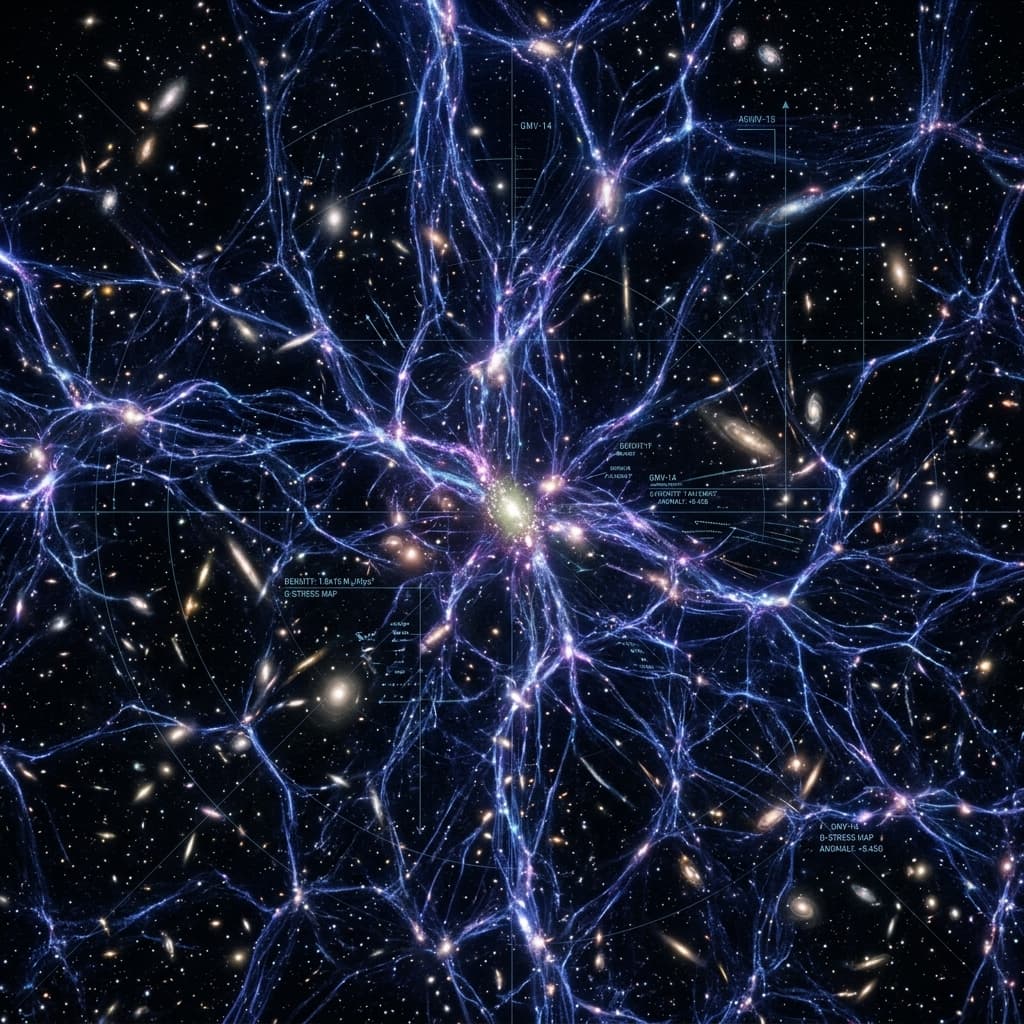
DARK MATTER
SCIENTIFIC SUMMARY
SEC. IDark matter is not a single substance. It is a family of electromagnetically non-participatory particles and their composite states, a parallel sector of matter that shares the universe with ordinary baryonic matter but does not interact with it through any force except gravity.
Its existence has been inferred through gravitational effects for the majority of Terran scientific history. Its internal structure has been resolved only since the development of graviton-based sensing technology in the mid-2700s CE.
The foundational physical fact governing all dark-sector science is that gravity couples to all energy-momentum regardless of sector membership. Gravity is the one interaction they share with ordinary matter, which makes graviton-based systems the sole available channel for dark matter detection and manipulation.
THEORETICAL FRAMEWORK
SEC. IIThe Universal Coupling Principle
Dark-sector particles do not participate in the electromagnetic force. They carry no electric charge, do not couple to photons under ordinary conditions, and take no part in conventional chemistry. They do not interact with the Higgs field; their mass is a dark-sector property, not a Standard Model quantity.
Gravity is the exception. Gravity couples to all energy-momentum regardless of sector membership. It is, in the precise sense, universal. Dark-sector particles produce gravitational effects detectable across galactic distances for this reason, and graviton-based systems are the only interaction channel available to Terran technology.
Fundamental Particle Taxonomy
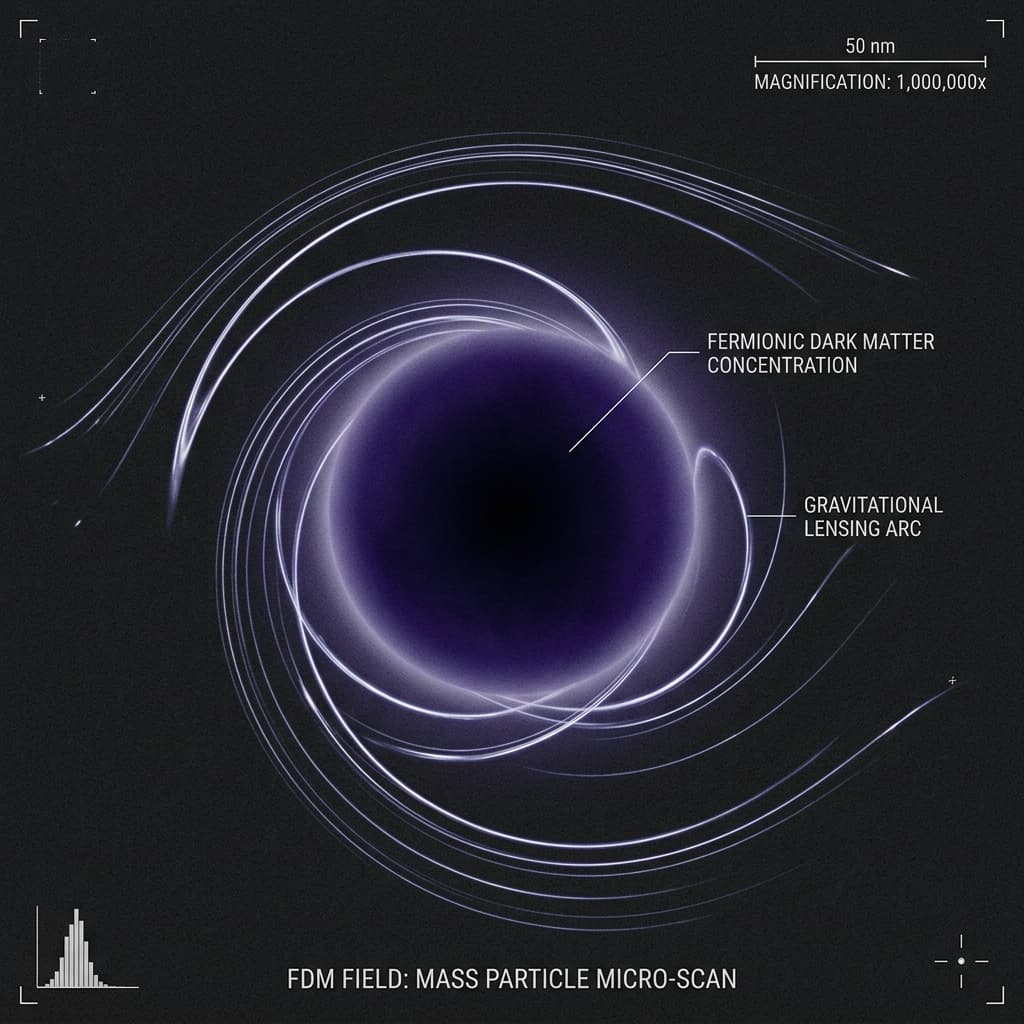
Umbron
The primary dark-sector mass particle. Umbrons are fermions; they carry the bulk of dark matter mass in all observed environments. Umbron density is the primary determinant of dark matter tier classification. Umbrons do not annihilate with Standard Model matter and interact with Standard Model particles only through the gravitational field.
DENSITY CLASSIFICATION / TAXONOMY
SEC. IIIDark matter across the galaxy is not uniformly distributed. The five-tier density classification organizes the recognized dark matter states by particle composition and gravitational environment. DM-β represents the dominant state in inhabited space and the baseline against which all dark-sector survey instruments are calibrated.
Location Focus: Dark matter deserts; cosmic voids
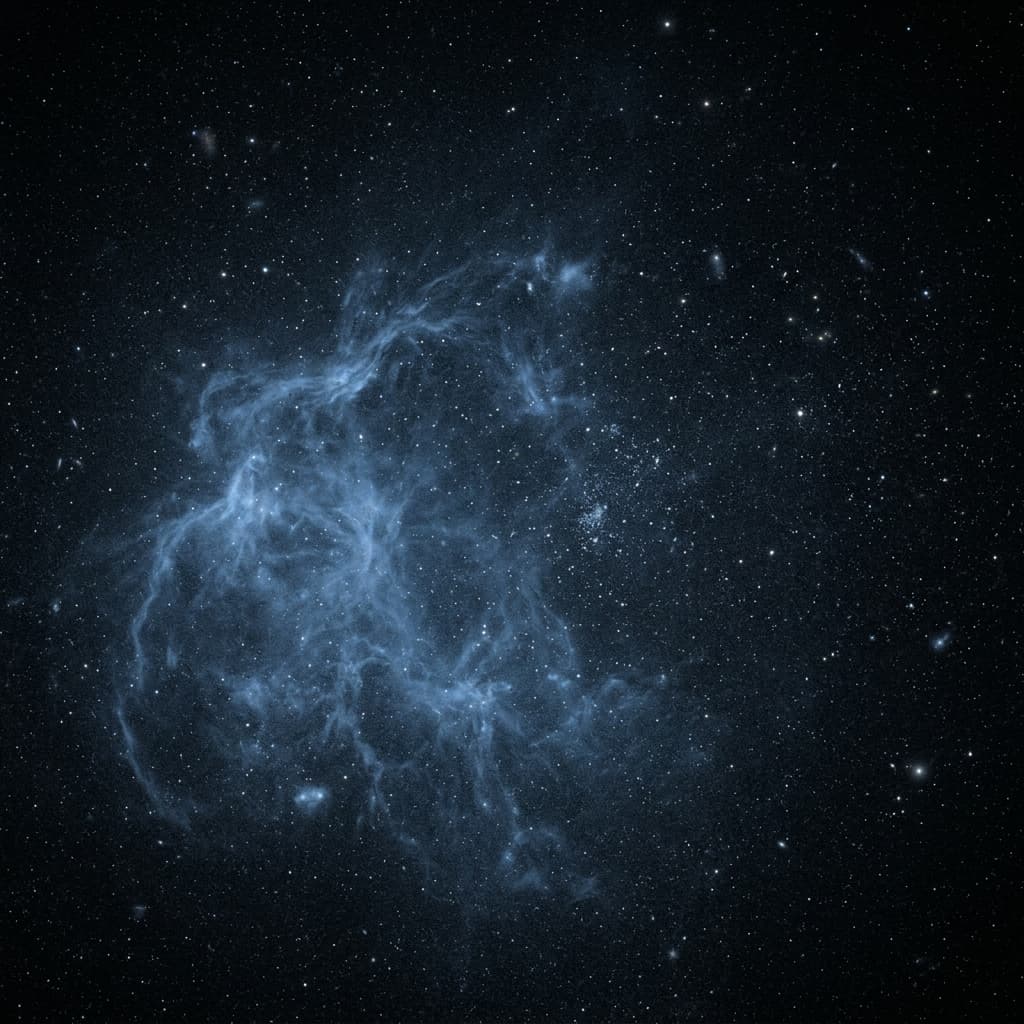
Location Focus: Deep interstellar; low-mass regions
Location Focus: Inhabited space; most of the galaxy

Location Focus: Stellar halos; binary environments; galactic center

Location Focus: Neutron star halos; black hole environments
RESEARCH HISTORY
SEC. IVDark matter characterized through gravitational effects only; no particle-level access
Graviton-based systems operational; dark-sector observation becomes possible
Umbron and nultrino mass-state signatures detected and differentiated
Bindon exchange signatures confirmed
Five-tier density classification codified by AXIOM Advanced Physics Division
Tier classification adopted as reference standard by Unified Gravitic Engineering Standards
Cohron signatures confirmed; DM-δ tier validated from theoretical prediction
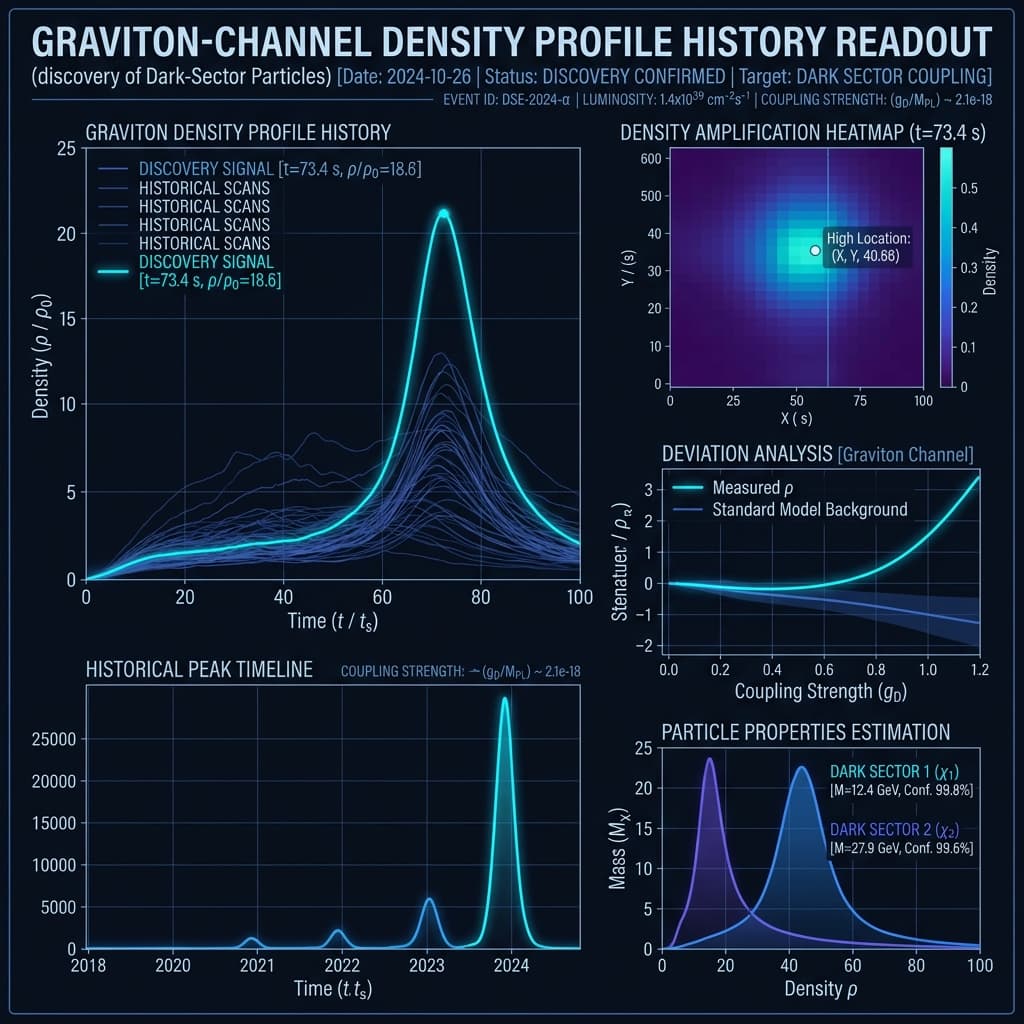
Graviton-channel signal timeline readout demonstrating early taxonomy isolation signatures.
ENGINEERING & TECHNOLOGY
SEC. V.AGraviton-channel observation platforms can characterize local dark matter tier through composite density profiling, umbron mass-state analysis, and bindon exchange signature detection. Systematic survey of dark matter distribution — tier mapping across stellar regions, identification of DM-∅ regions, characterization of DM-γ concentrations — is an active program within the AXIOM Advanced Physics Division.
Graviton-based systems capable of influencing dark-sector particle behavior at local scales are an active research area. Present capability is limited; graviton fields can perturb dark matter composite states in controlled laboratory conditions, but sustained large-scale manipulation of environmental dark matter tier is beyond current technology. Research at DM-γ sites, where composite structure produces measurable manipulation responses, has yielded the most significant results to date.
STRATEGIC & SCIENTIFIC VALUE
SEC. V.BDark matter constitutes the majority of mass in the galaxy. Any civilization with a mature understanding of dark-sector physics holds a foundational advantage in graviton-based technology development, galactic survey, and fundamental physics research. AXIOM dark-sector knowledge represents over two centuries of systematic observation.
DM-δ research is physically hazardous. Remote observation platforms operating near neutron stars and black holes sustain instrumentation attrition rates substantially above standard mission profiles. DM-δ research proceeds through remote sensor platforms only; no personnel authorization exists for DM-δ environments under current AXIOM protocols. DM-∅ regions present a planning uncertainty: their formation mechanism is unresolved, their boundaries cannot be predicted ahead of survey, and any route through unsurveyed space carries some probability of unmapped DM-∅ transit.
OPEN RESEARCH QUESTIONS
SEC. VI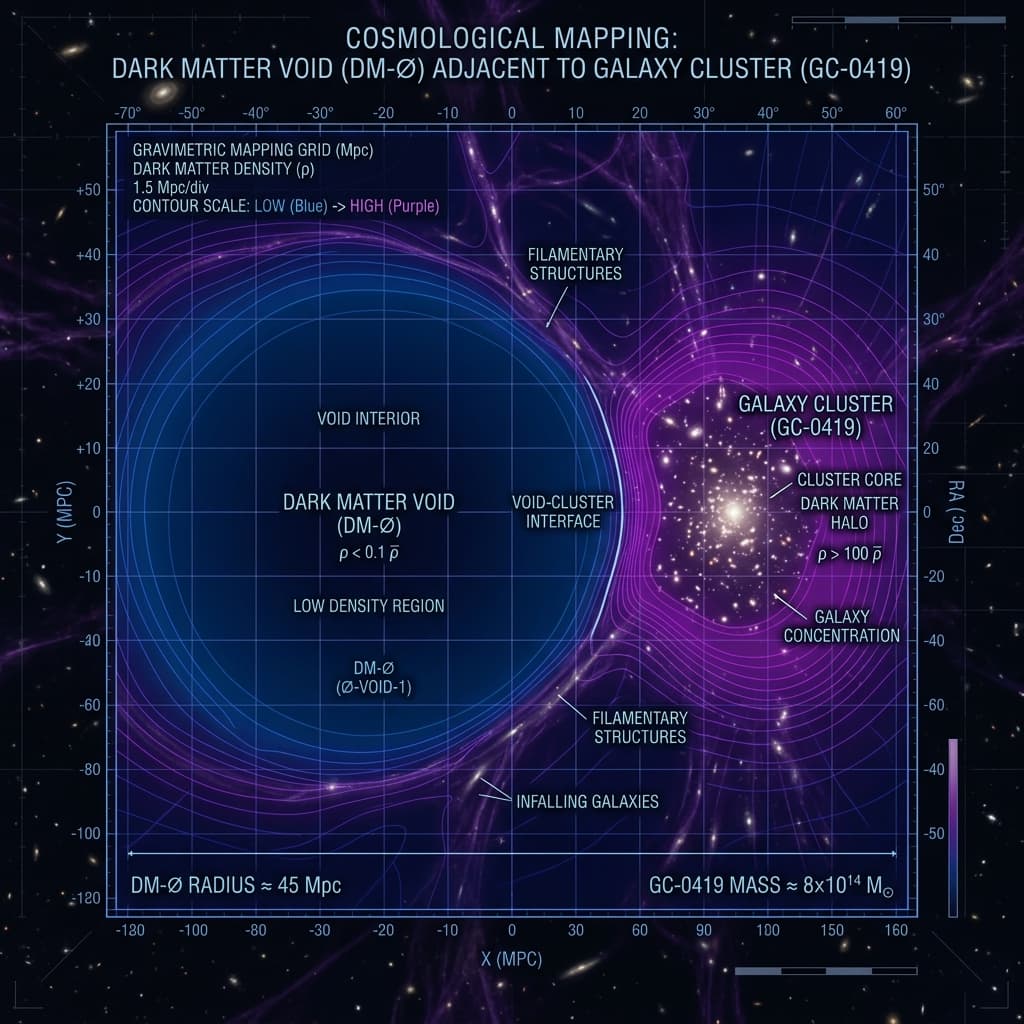
The mechanism by which dark matter deserts form and remain depleted is unresolved. Standard cosmological formation models do not predict regions of the observed extent and completeness. Whether DM-∅ regions are natural remnants, the product of historical events, or the result of processes not yet characterized remains open.
The conditions that trigger DM-γ composite formation from DM-β ambient state are understood at the observational level: gravitational shear environments concentrate dark-sector particles sufficiently for bindon exchange to sustain composite coherence. The precise formation threshold remains unresolved.
All current dark-sector characterization is indirect: graviton-channel observation produces inferred particle signatures rather than direct detection events. A technology capable of direct dark-sector particle interaction remains theoretical.