IM-9 SIPHON SYSTEMS

System Infrastructure Overview
An IM-9 siphon is a Terran stellar-scale industrial installation designed to extract Interstitial Matter Type-9 from the controlled interaction environment of a neutron star–black hole binary. Only two operational siphons exist: the Kordahl Siphon and the Myrral Siphon.
Under the correct conditions, the black hole's ergosphere, the surviving neutron star's magnetic and energy output, and the binary's gravitational shear generate a continuous extraction gradient. Diffuse IM-9 already present in the surrounding volume concentrates inside that active interaction zone, then moves along a maintained spacetime corridor into staged containment. The extraction state exists only under active field maintenance; it collapses when conditions fail.
Interstitial Matter Type-9 Basis
IM-9 is formally designated Interstitial Shear Condensate: the only confirmed ambient-persistent interstitial matter type. Unlike every other known IM classification, IM-9 is not produced exclusively under artificial or localized conditions. It exists throughout space as diffuse trace concentrations, too sparse to detect with standard instrumentation and far below any useful threshold. It moves in slow, current-like distributions through interstellar and interplanetary volumes — present everywhere, actionable nowhere, without intervention.
Under extreme conditions — specifically the spacetime shear, frame-dragging, and phase-boundary stress produced by neutron star–black hole interaction — diffuse IM-9 accumulates. The siphon does not produce IM-9. It constructs and maintains conditions under which IM-9 already present in the surrounding volume collects, condenses to extractable density, and can be harvested at industrial scale.
Most interstitial matter types require artificial generation conditions and collapse or dissipate when those conditions are removed. IM-9 differs: it is ambient-persistent, existing in trace form throughout space before any Terran intervention and persisting after extraction under proper containment.
The operational distinction is not that IM-9 forms under extreme conditions. It exists whether those conditions are present or not. The distinction is that extreme shear conditions concentrate it to a density where industrial extraction becomes viable. Without concentration, IM-9 remains diffuse: present, detectable in principle with sufficient instrumentation, and useless at scale. That single property, ambient persistence combined with engineerable concentration, makes mature Terran FTL possible. Earlier IM types could produce useful effects at laboratory or prototype scale; none could support stable, civilization-scale warp operations.
Stellar Remnant Collapse Mechanics
An IM-9 siphon begins with a binary neutron star system. One neutron star is intentionally collapsed into a black hole; the other remains intact as the siphon's power and field-control partner. The final configuration is an engineered compact-object binary designed for extraction, not a naturally occurring black hole system.
Binary neutron stars are preferred because they begin as two extreme compact objects already gravitationally bound. A suitable extraction system does not require finding a rare natural black hole–neutron star pair with favorable geometry; one can be made.
The Kordahl collapse was the first successful artificial stellar-mass black hole event; earlier programs had produced short-lived, sub-stellar-mass objects.
Before attempting neutron-star collapse, Terrans developed the underlying capability through controlled compression experiments conducted in isolated star systems. These precursor programs were not designed to produce long-lived extraction endpoints; their purpose was to prove that Terran field systems could compress massive bodies past their stability limits and induce collapse under controlled conditions.
The earliest successful tests were conducted on isolated super-Jovian gas giants selected for mass, remoteness, and limited civilizational value. These bodies were compressed using prototype dark matter injection systems, gravitic containment scaffolds, and collapse-vector models originally developed for compact-object research. The resulting black holes were small, unstable, and evaporated quickly through Hawking radiation.
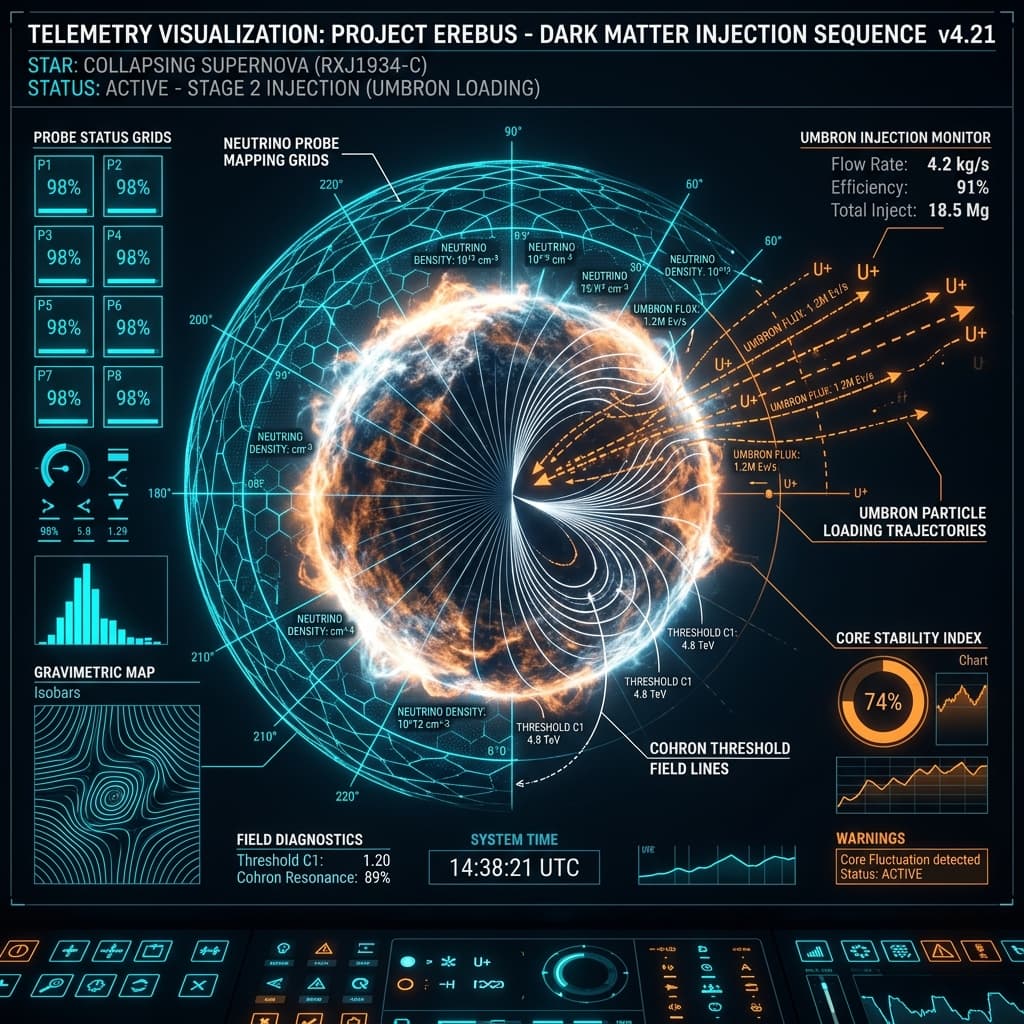
The collapse trigger is controlled dark matter injection. A neutron star resists collapse through neutron degeneracy pressure. To collapse it, that resistance must be overcome; how it is overcome determines whether the resulting black hole is a usable extraction endpoint or debris.
Siphon System Infrastructure
The siphon corridor is an actively maintained spacetime control volume spanning tens of AU between the two compact remnants. Activity across a siphon is constant: correction, monitoring, and repair, driven by the operating environment rather than the scale of any individual structure.
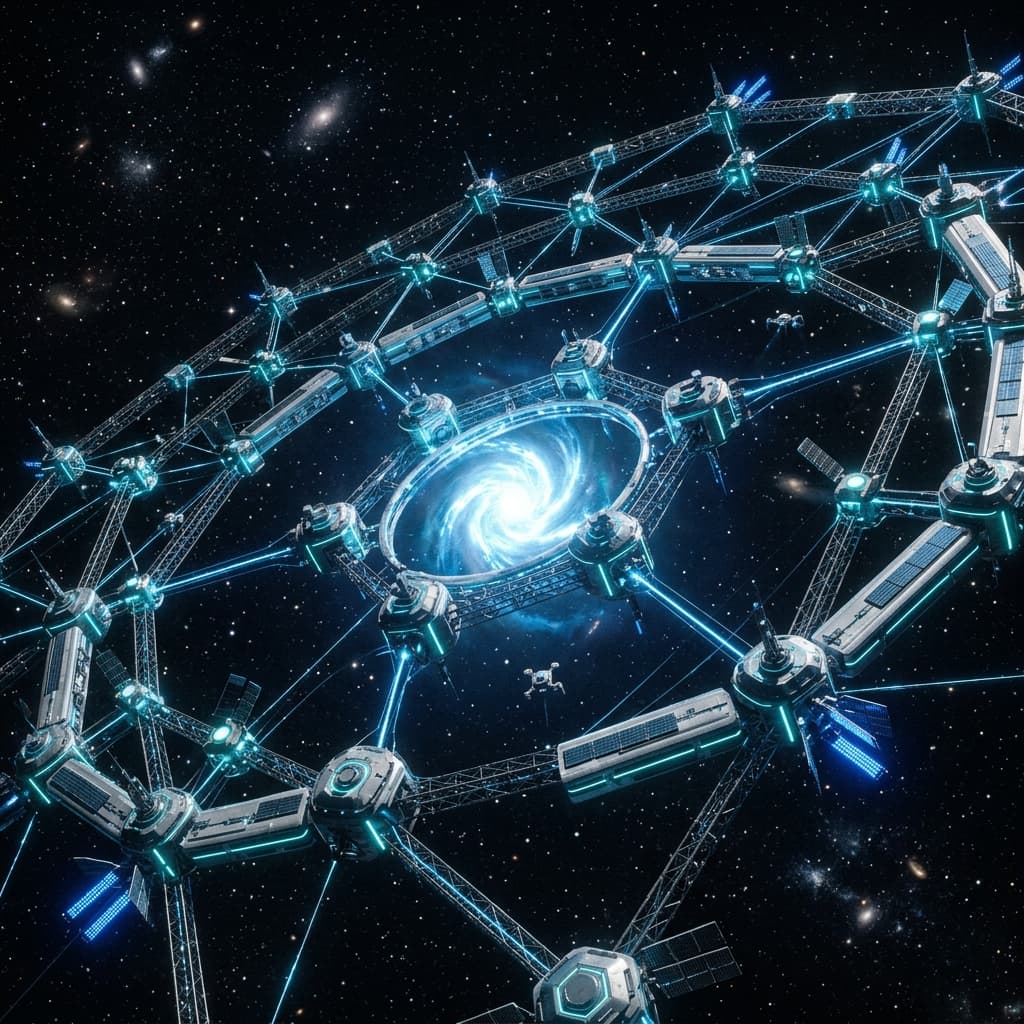
Mobile Corridor Regulator Frames (MCRFs) are large autonomous or semi-autonomous field-control platforms deployed along the active siphon corridor. They are movable infrastructure, not ships in the conventional sense. MCRFs drift, rotate, reseat, and reposition along the IM-9 flow as the binary orbit shifts, black hole spin precesses, and neutron star output fluctuates.
Kordahl vs. Myrral Siphons
PARAMETER | KORDAHL SIPHON | MYRRAL SIPHON |
|---|---|---|
| Generation | First operational siphon | Second-generation successor |
| Stellar remnant pair | Tarnac (NS) & Velshar (BH) | Elyrion (NS) & Tharex (BH) |
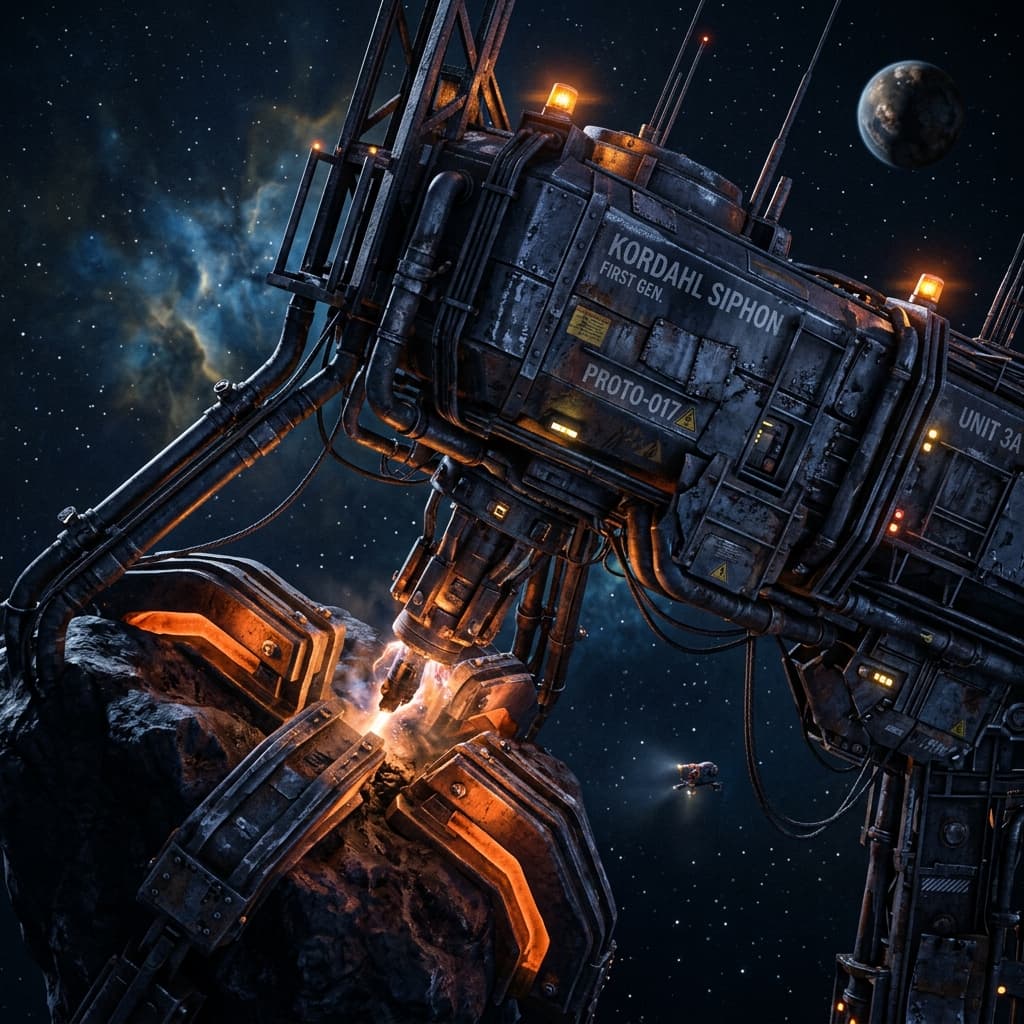
| Separation range | ~80–100 AU (Conservative) | ~35–60 AU (Tighter spacing) |
| Shear environment | Lower intensity, wide tolerances | Higher intensity, active regulation |
| Anchor configuration | Few massive structures | Distributed multi-node system |
| Corridor regulator nodes | Large, slow, human-supervised | Smaller, numerous, fully autonomous |
| Vault containment | Fixed-core vaults (massive) | Modular detachable pods (dynamic) |
| Failure isolation | Corridor-wide shutdowns | Segment-by-segment isolation |
| Aesthetic character | Heavy, weathered industrial scars | Clean, distributed precision instrument |
| Legacy components | Precursor collapse-test hardware | Purpose-built second-generation systems |
Failure Modes & Safety Protocols
Siphon safety is built around three principles: 1) Do not fight the whole system at once — the corridor is segmented, and failing segments are isolated and let fail. 2) Sacrifice hardware before people or vaults — regulator frames, extraction arcs, and drones are expendable; crew habitats and vaults are not. 3) Let the black hole absorb failed containment via emergency dump paths.
Raw IM-9 cannot be treated as ordinary cargo. It must pass through staged stabilization before storage. Containment requires redundant gravitic and null-inertial systems. Military-grade containment uses automatic isolation lockdown on primary field degradation. Vault systems are physically separated to reduce cascade risk.
Both siphons maintain black-hole capture paths for emergency disposal. If a vault, extraction packet, or containment capsule cannot be stabilized, it may be routed into the artificial black hole. This procedure is destructive, expensive, and potentially destabilizing, but preferable to a containment cascade.
Diplomatic & Ethical Perspectives
Kordahl and Myrral are the only operational production sources for industrial-scale IM-9. Terran interstellar civilization depends on these two production points. If one siphon fails, production drops catastrophically; rationing begins. If both fail, Terran FTL enters terminal decline after stockpile depletion; interstellar trade collapses, and frontier worlds become isolated.
New siphons cannot be built quickly. A suitable site requires a binary neutron star system, appropriate mass range, controllable orbital geometry, acceptable strategic location, political access, security feasibility, enormous construction investment, and ethical authorization to collapse a neutron star.
The Pelari oppose artificial neutron star collapse on philosophical and ecological grounds. They recognize Terran dependency but do not accept the practice as morally clean. Pelari involvement in siphon construction and operation is non-participatory; their formal engagement extends only to observation protocols and inspection interfaces.
Terrans justify siphons as necessary infrastructure: IM-9 enables stable FTL; it cannot be replaced by earlier IM types; pre-siphon acquisition methods were catastrophically inefficient; only two sources exist; and strategic parity depends on continued operation.
The Chorus remain observational, with no operational role in siphon infrastructure. Their involvement becomes relevant around anomalous events, communication mediation, or philosophical interpretation.
Terran opposition exists across several camps: scientific ethicists opposed to forced stellar collapse; frontier movements concerned about IM-9 dependency; anti-AXIOM factions opposed to centralized control; ecological restorationists who view compact-object alteration as irreversible damage; and sabotage movements.