
INTEGRATED REGOLITH
CONDITIONING PROGRAM
TECHNOLOGY OVERVIEW
The Integrated Regolith Conditioning Program (IRCP) is a multi-phase environmental remediation suite of Terran origin. Developed by the UTC Terraforming Authority (UTCTA), Mars Division, with initial research by the University of New Syrtis Geomicrobiology Laboratory.
PURPOSE
The IRCP eliminates the chemical toxicity of native Martian regolith and converts it to substrate capable of supporting biological activity.
Untreated Martian soil contains perchlorate compounds at concentrations lethal to Earth-derived organisms, lacks the organic content and microbial communities necessary for plant growth, and contains elevated concentrations of heavy metals in bioavailable forms.
The IRCP addresses each of these problems in sequence through three distinct biological and biochemical phases. Treatment is permanent: once all three phases complete in a given zone, no maintenance or re-application is required.
TECHNICAL SPECIFICATIONS

Phase I — Perchlorate Reduction Treatment (PRT)
The primary toxicity of native Martian regolith derives from perchlorate salts (ClO₄⁻), which are present at concentrations averaging 0.5–1.0% by mass across most surface zones.
Phase I deploys a consortium of engineered perchlorate-reducing bacteria (PRB), derived from terrestrial strains modified for Martian conditions. The bacteria metabolize perchlorate, reducing it stepwise to chloride ion and molecular oxygen.
Phase II — Soil Conditioning Program (SCP)
With perchlorate eliminated, Phase II addresses structural and nutritional inadequacy. Treated Martian soil is chemically safe but biologically barren.
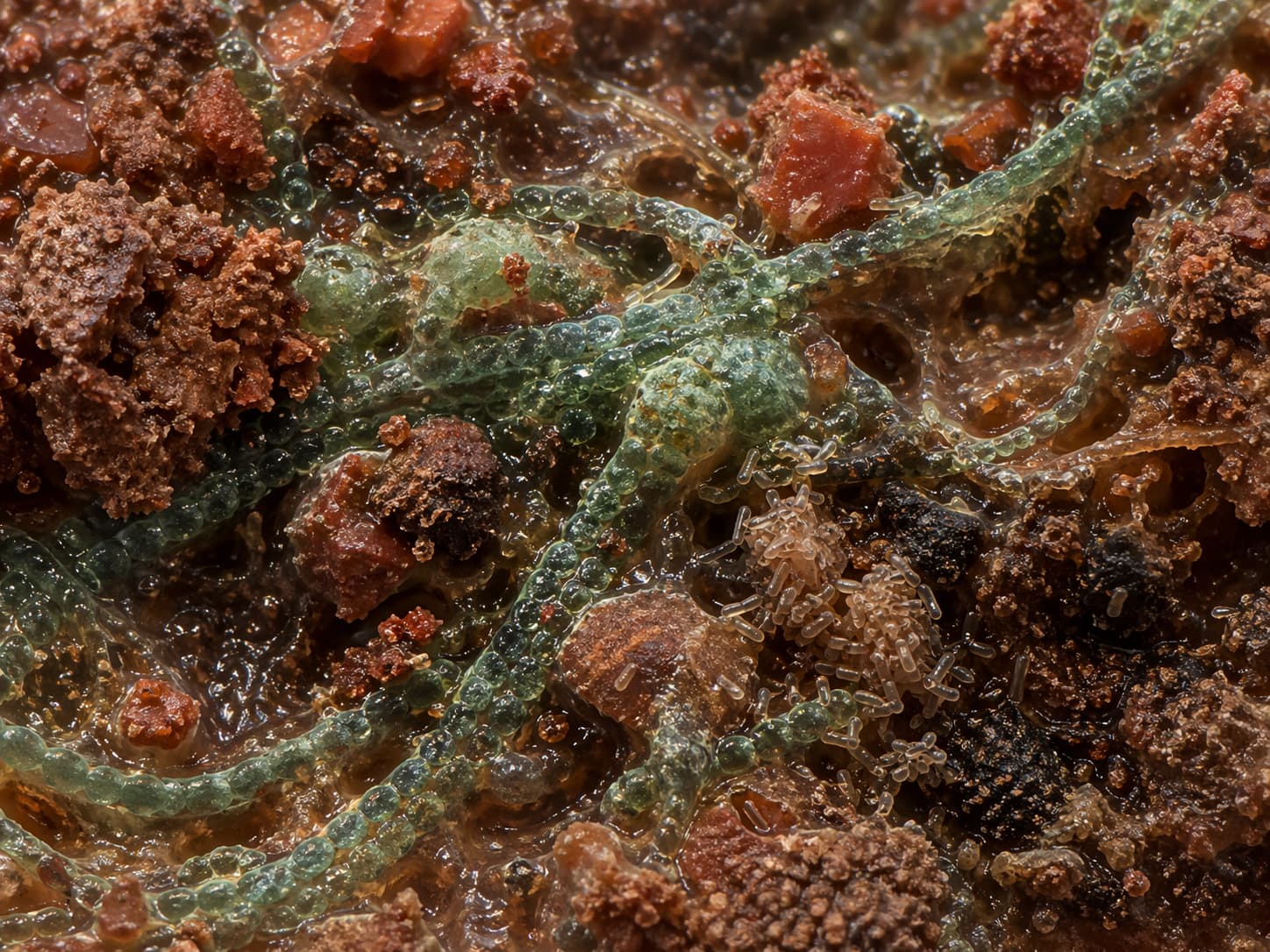
Phase II deploys a succession of engineered microorganism communities that build functional soil over decades. Cyanobacterial strains fix nitrogen, heterotrophic decomposers process biomass into humic compounds, and mycorrhizal fungal networks establish self-sustaining biological systems.
Phase III — Metal Sequestration Treatment (MST)
Runs concurrently with Phase II. Martian regolith contains elevated concentrations of iron oxides, arsenic, chromium, and manganese compounds.
Phase III deploys biomineralizing bacterial consortia that precipitate dissolved heavy metals into stable, insoluble mineral forms (sulfides and carbonates).
PHYSICAL PARAMETERS
PERFORMANCE CHARACTERISTICS
DEVELOPMENT HISTORY
CONCEPTION
Martian perchlorate contamination was identified as a critical barrier to surface agriculture and open colonization. UTCTA commissioned foundational research in 2380 CE.
RESEARCH PHASE
University of New Syrtis Geomicrobiology Laboratory conducted primary strain development between 2380–2450 CE.Significant challenges involved engineering PRB strains for low oxygen and night temperatures while retaining self-limiting behavior.
TESTING AND VALIDATION
Pilot testing in Hellas Basin (2491–2503 CE) and Argyre Basin (2508–2522 CE). Full three-phase integration testing ran from 2519–2531 CE in Amazonis Planitia, certified complete in 2576 CE.
DEPLOYMENT
Full-scale deployment began in 2531 CE, prioritizing population centers (Tharsis Manufacturing District completed 2680 CE). As of 2950 CE, operates primarily at the expanding terraforming frontier.
APPLICATIONS & STRATEGY
PRIMARY APPLICATIONS
Surface preparation for Martian agriculture, open habitation zones, and surface industrial facilities. Eliminates the resource cost of sealed hydroponic systems for food production.
SECONDARY APPLICATIONS
Treated soil used as construction aggregate. Phase II biological activity contributes measurably to atmospheric oxygen production.
POTENTIAL APPLICATIONS
Evaluated for potential adaptation to other perchlorate-bearing worlds identified in Commonwealth survey data. Exportability depends on target world conditions.
STRATEGIC ASSESSMENT
MILITARY
ECONOMIC
DIPLOMATIC
SAFETY & ETHICS
HAZARD ASSESSMENT
ETHICAL CONSIDERATIONS
Primary Malfunction Mode
Self-limiting design reduces accident risk. Premature termination is the primary failure mode (results in incomplete treatment, requires re-inoculation).
Worst-Case Scenario
Introduction of IRCP strains to biologically active world would represent serious ecological contamination.
OPERATIONAL DOCTRINE
AUTHORIZATION
PERSONNEL
MAINTENANCE
FUTURE DEVELOPMENT
Enhancement Priorities
Accelerating Phase II handoff in cold frontier zones. Exploring cold-adapted cyanobacterial strains.
Related Research
Phase III biomineralization work informing asteroid mining slurry processing at Ceres.
Long-Term Outlook
Will complete treatment of all projected habitable zones by 2200 CE. Operational wind-down by ~3050 CE.
APPENDICES
PERFORMANCE DATA (SELECTED ZONES)
| Zone | Phase I Complete | Phase II Complete | Area | Notes |
|---|---|---|---|---|
| Amazonis Planitia Test Zone | 2503 CE | 2576 CE | 400 km² | First full integration test |
| Tharsis Perimeter (Zone 1) | 2612 CE | 2680 CE | 18,400 km² | Primary industrial corridor |
| Hellas Basin Perimeter | 2648 CE | 2720 CE | 22,000 km² | High perchlorate concentration |
| Utopia Planitia Ag. Zone | 2701 CE | 2798 CE | 31,000 km² | Largest single certified zone |
| Current frontier deployment | Ongoing | — | ~410,000 km² | Active treatment |
INCIDENT HISTORY
No significant deployment incidents on record. Three cases of premature PRB population collapse in polar frontier zones (2841, 2867, 2891 CE) resolved by re-inoculation. Root cause: lower-than-projected subsurface moisture.