KELEDH OVERFORGE
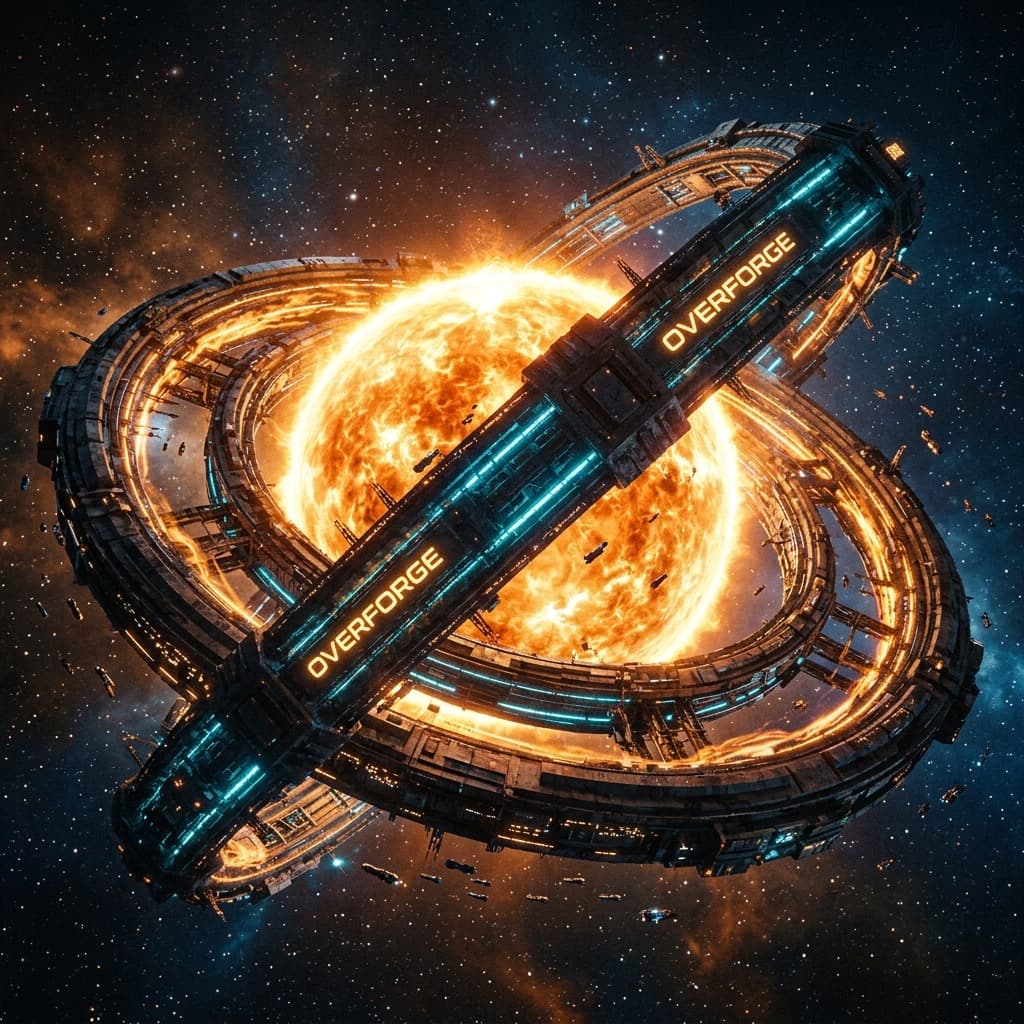
The Keledh Overforge represents the most advanced materials fabrication system known to exist in the galaxy. Unlike Terran Dyson rings (energy collection) or IM-9 siphons (exotic matter extraction), the Overforge uses a main-sequence star as an active fabrication environment to create overmatter—a deliberately forged phase of matter that defies conventional material science.
Terran civilization cannot currently replicate this technology. The materials science knowledge gap represents a strategic vulnerability that may persist for centuries.

Count: 30–40 per installation
Length: ~100,000 km each
Embed into gravitational gradient layer to redistribute stellar mass flow and generate localized high-gravity pockets.
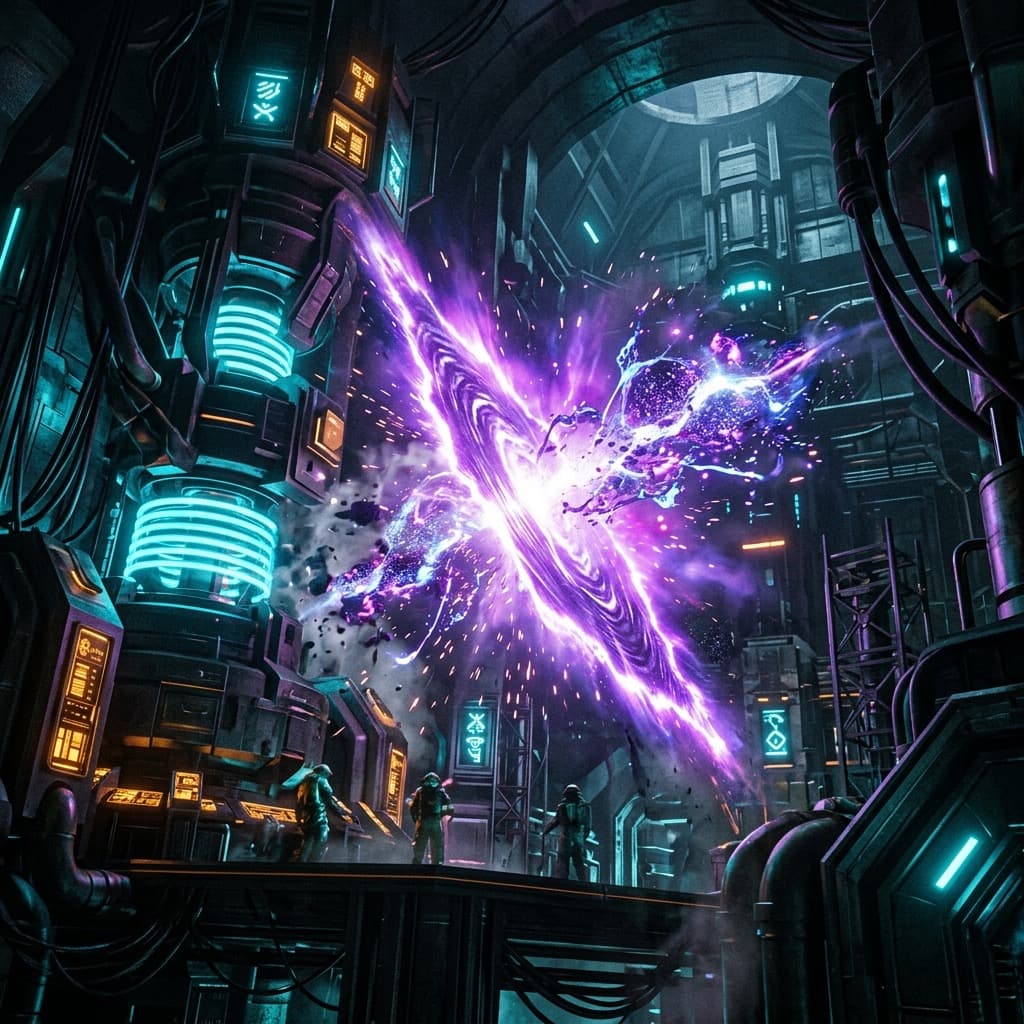
Keledh reserve overmatter for applications where failure is existential.
Any system requiring field modification.
Experimental or prototype systems.
Components subject to combat damage.
Short-lifecycle or disposable systems.
Applications where repair might be needed.
Overforge Primary Load Paths: Gravity spine cores, ring-to-ring structural bridges, pressure containment vessels, and stellar ingestion framework.Other Megastructures: Orbital forge suspension elements, Dyson structure critical segments, habitat ring primary frames, and theoretical space elevator tethers.
Inertial Unity Frameworks: Structural skeletons that bind vessels into single inertial objects and allow extreme acceleration without internal shear.FTL Corridor Stabilizers: Components that withstand differential stresses of corridor formation, where no conventional material survives phase transition.Reactor Containment and Navigation References: Absolute containment for fusion cores and drift-immune position/orientation standards.
Keledh doctrine forbids overmatter use in systems requiring field modification, experimental or prototype systems, components subject to combat damage, short-lifecycle systems, or applications where repair might be needed.
Reason: Overmatter cannot be repaired. Its use must be permanent.
Overmatter structures routinely withstand forces that would tear conventional starships apart, shear IM-9 reinforced frames, collapse Pelari biostructures, or stress Terran warp rings beyond operational limits.
Conventional materials last years to decades; exotic alloys last decades to a century; IM-9 reinforced materials can last centuries; overmatter is projected to last millennia with no observed degradation.
Overmatter enables thin-walled pressure vessels under extreme stress, kilometer-long unsupported spans, negative curvature shells, minimal-section rings, and hollow frames bearing megaton loads.
Keledh ships with overmatter frames routinely perform maneuvers that would liquefy Terran crews, snap conventional ship spines, tear superstructure from hull, or cause permanent structural deformation.
The limiting factor becomes crew survival, not structural integrity.
Extensive prototype development (often 100+ complete variants).
Catastrophic failures celebrated as complete system data.
Final design operates unchanged for intended operational lifetime.
No modifications, upgrades, or 'improvements'.
Deploy 'good enough' version.
Monitor for problems over 5-10 years.
Issue patches and reinforcements.
Continuous maintenance throughout life.
Terrans cannot replicate overmatter fabrication. Estimated realistic development timeline is 400-600 years.
AXIOM Recommendation: Pursue Alternative Approach (hyperalloy acquisition) while maintaining long-term research.
Terrans need Keledh for SIGMA-class structural materials and megastructure repair.
Keledh tolerate Terrans for access to IM-9 exotic matter and advanced warp theory.
Physics: Exact mechanism of spatial shear transition, quantum entanglement role in global coherence, gravity spine operational mathematics, and stellar stabilization during asymmetric extraction.Materials Science: Phase-lattice alloy composition, neutrino interaction with compressed substrates, limits of overmatter coherence breakdown, and hyperfrequency pulse-forging parameters.Engineering: Ingestion Ring thermal management, ablative regeneration mechanisms, magnetic suspension field geometry, and long-term structural aging.
Priority 1: Hyperalloy characterization through non-destructive analysis, stress testing, stability monitoring, and Terran-viable analogue development.Priority 2: Gravity manipulation theory through Keledh collaboration, scaled-down field generators, localized gravity pocket research, and non-fabrication applications.Priority 3: Alternative fabrication approaches including subscale overmatter production, quasi-overmatter materials, IM-9 hybrid materials, and synthetic coherence mechanisms.Priority 4–5: Cultural exchange around Keledh engineering philosophy and strategic independence through indigenous SIGMA-class alternatives.
Areas of mutual interest include Dissonant Bloom structural resonance countermeasures, IM-9/overmatter hybrid applications, extreme environment habitat construction, and megastructure failure prediction models.
Potential breakthroughs may emerge from Terran mathematical physics combined with Keledh materials intuition, IM-9 exotic matter combined with overmatter structural properties, warp field stabilization using overmatter frameworks, and bio-compatible derivatives of interest to the Pelari.
AXIOM-Sigma Materials: All overmatter samples and derivatives, detailed Overforge specifications, phase-lattice manufacturing data, and gravity spine operational parameters.Distribution Restrictions: Need-to-know basis only; AXIOM Council authorization required; no private sector access without override; allied species limited access case-by-case.
Overmatter samples require SIGMA-class containment facilities, constant magnetic suspension, temperature control within ±10 K, microgravity environment, vacuum or inert atmosphere, and no unauthorized proximity within 200 meters.
Containment failure requires immediate 300m evacuation, remote shutdown of local power systems, magnetic field collapse protocol, and disposal of contaminated reverted material.
Prohibited Exports: Overmatter fabrication documentation, phase-lattice alloy formulations, gravity manipulation specifications, and Overforge construction data.Controlled Exports: Finished hyperlattice components for allied powers, de-rated reactor designs, general structural engineering principles, and non-critical hyperalloy specifications.
If Vorokh acquire overmatter technology: immediate AXIOM emergency session, military readiness elevation, accelerated indigenous development programs, and potential preemptive diplomatic intervention.
If rogue polities acquire samples: intelligence gathering priority, distribution-chain tracking, compromised-source identification, and possible retrieval operations.
The Keledh Overforge represents a technological achievement that fundamentally alters the strategic landscape of materials science. Overmatter is not merely "better material"—it represents a different category of engineered matter with properties that challenge fundamental assumptions about structural engineering.
Key Findings: Terrans cannot currently replicate this technology; strategic alliance with Keledh is critical; overmatter enables engineering impossible by other means; the materials science gap is one of the most significant technological asymmetries in known space; long-term independence requires sustained multi-generational research.
Short-Term (0–50 years): Maintain and strengthen Keledh alliance, acquire hyperlattice alloys for critical systems, develop complementary technologies, and respect Keledh technological boundaries.Medium-Term (50–200 years): Develop quasi-overmatter alternatives, advance gravity manipulation capability, build subscale test facilities, and reduce critical dependence gradually.Long-Term (200+ years): Achieve independent overmatter production capability, construct Terran-designed stellar fabrication facilities, develop novel SIGMA-class materials, and maintain peer status with Keledh materials science.
The Keledh approach to materials science represents a fundamentally different engineering philosophy: iteration during design, permanence during deployment; catastrophic failure as complete data, not setback; replacement over repair, redesign over modification.
Terran engineering emphasizes flexibility, repairability, and continuous improvement through modification. Keledh engineering emphasizes exhaustive iteration followed by permanent deployment.
The Overforge stands as both inspiration and challenge—a demonstration of what is possible when evolutionary necessity, cultural obsession with permanence, and willingness to iterate exhaustively converge across millions of years.
Function: Energy collection.Star Contact: No; orbital distance maintained.Primary Output: Power generation.Fabrication Capability: None.
Function: Exotic matter extraction.Energy Source: Black holes / neutron stars.Primary Output: IM-9 exotic matter.Materials Capability: Uses exotic matter, does not create it.
Function: Materials fabrication.Star Contact: Yes; partial submersion.Primary Output: Overmatter and hyperalloys.Unique Capability: Creates new phases of matter.
The Overforge is the only known megastructure that uses its energy source as the fabrication environment rather than merely extracting resources from it.