NULL-FIELD DEFENSIVE ENVELOPE
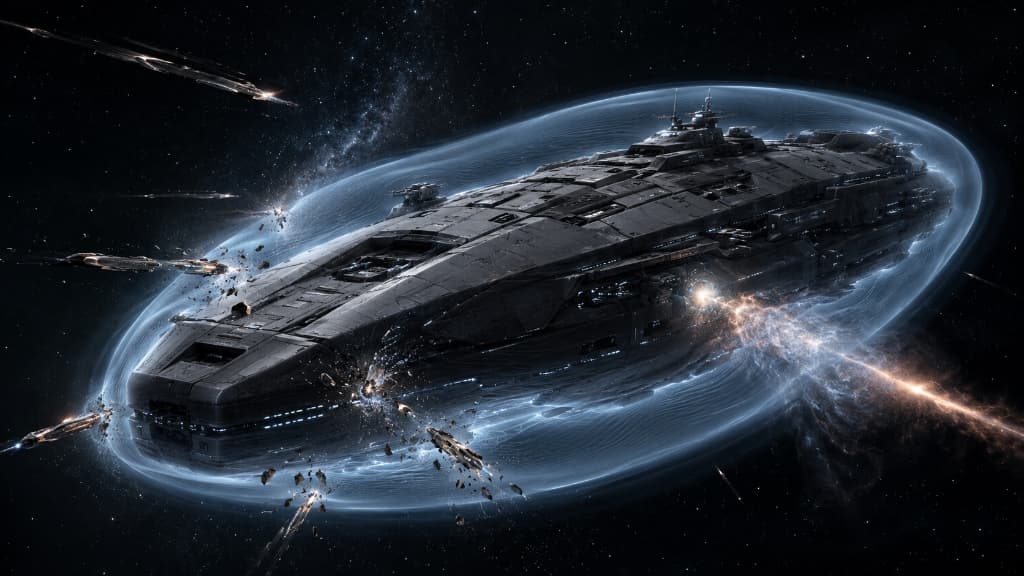
Inertial Deflection System
The Null-Field Defensive Envelope (NFDE) generates a continuous inertial gradient field around a protected hull. Incoming mass crossing the field boundary enters a zone of progressive inertial dampening that subjects it to differential deceleration across its volume, producing simultaneous compressive and shear stress sufficient to fragment, deflect, or prematurely detonate the majority of mass-delivery threats.
The field does not create a physical barrier. It interacts with mass in transit, using the kinetic energy of incoming threats as the primary mechanism of their destruction.
Deflection and Dampening Specifications
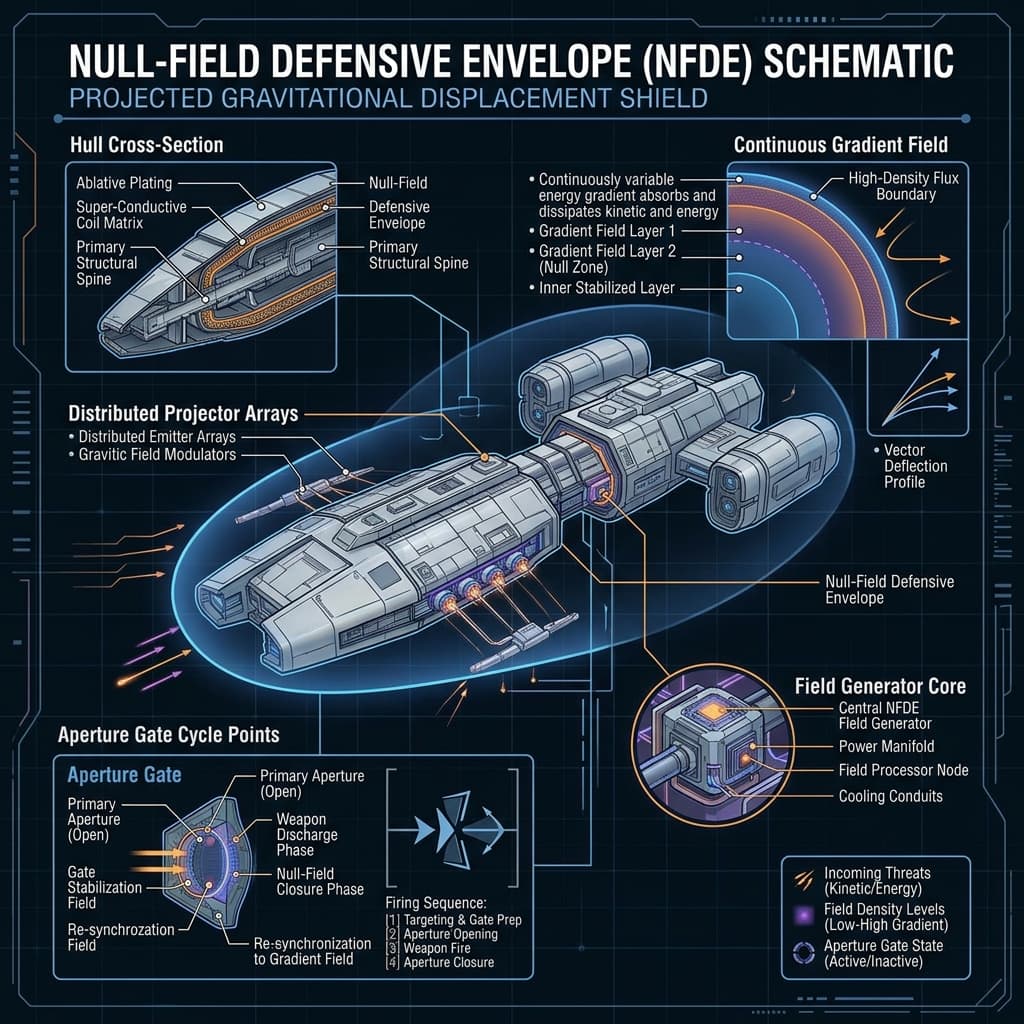
The NFDE applies null field physics in a defensive configuration. Null fields generate localized zones of altered inertial geometry through IM-9 arranged in specific non-propulsive configurations.
Where warp drive systems use IM-9 to actively reshape spacetime for FTL transit, null field configurations produce passive inertial gradients without spacetime manipulation. The energy requirements are correspondingly lower, placing null field operation well within the IM-9 budget of vessels already carrying warp-capable drives.
The geometry that produces a defensive gradient rather than a drive effect requires precise IM-9 arrangement and continuous field management computation. The NFDE is a dynamic, aperture-managed field whose geometry is continuously adjusted by the NEMS in response to threat vectors, weapons cycling requirements, and drive system separation margins.
From Shielding to Tactical Deflection
Null field dampeners entered service as warp drive components during the Phase III manned warp testing era to suppress vacuum backflow fluctuations and protect crews. Radiation shielding configurations predate combat defensive concepts; survey missions operating in inner stellar environments identified particulate radiation deflection as a secondary property, which was commercialized in the late 2920s.
Transitioning to a combat defensive envelope required solving two major problems: aperture management for outbound fire, and geometric separation from active drive IM-9 fields. Aperture management was solved through the NEMS platform, which collapses and restores local gradients in millisecond gate cycles synchronized to weapon firing pulses.
NROC combat trials began in the early 2930s. Deployment commenced on capital ships carrying sufficient power margins, followed by installation-class systems for orbital and planetary defense.
NEMS Interception Profile Matrix
Kinetic Projectiles
ACTIVE INTERCEPTFragment or deflect within the gradient; effectiveness scales with kinetic energy. Steeper hypervelocity penetrators have less transit time through the gradient, requiring hull armor backstops.
Explosive Warheads
STANDOFF DETONATECarrier and casing fail during transit or detonate at field boundary standoff; fusing behavior varies by warhead design.
Plasma Weapons
THERMAL wash DISPERSALCoherence disrupted within gradient; arrives as diffuse thermal wash.
Particulate Radiation
MASS DEFLECTIONField decelerates and deflects mass-carrying particles regardless of charge; highly effective against neutron flux.
Electromagnetic Radiation
BYPASS / NO RESPONSENo interaction; lasers, X-rays, gamma rays, and EMP pass through the field unimpeded.
Tactical and Secondary Deployments
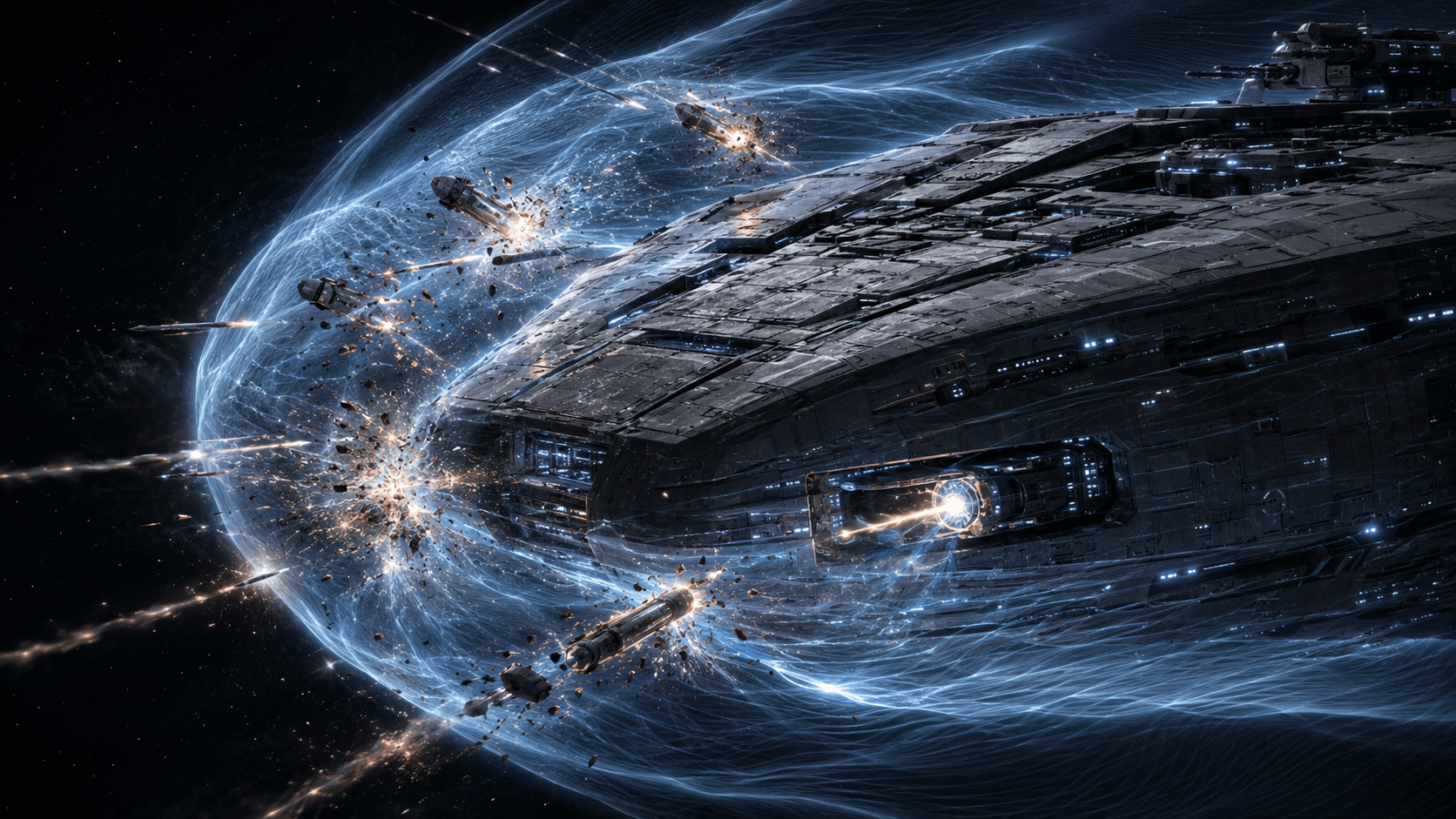
Combat defense represents the primary deployment case, safeguarding capital assets against mass-delivery armaments and high-yield energetic payloads. It serves as the uppermost layer of the vessel’s defense-in-depth layout, working in synergy with composite plating.
Secondary operations include solar wind and high-radiation field crossings. By running NEMS in passive pulse modes, survey vessels can navigate extreme stellar environments without exposing crew or sensitive instrumentation to cosmic radiation.
Envelope held continuously at full gradient depth. NEMS manages millisecond aperture gate cycling to permit outbound weapons fire.
Tactical Value and Limitations
Real-time computation limits degradation during dense swarm-pattern barrages directed at clustered points on the hull.
Continuous full-gradient operation depletes dedicated reserve fuel assets, restricting sustained combat deployment.
Apertures collapse momentarily to permit own-weapons fire, creating micro-windows that high-spec targeting systems can exploit.
Forces adversaries to pivot from kinetic loadouts to directed electromagnetic/laser systems. Compels layered defense architectures.
Capital ship installation runs 600M to 1.2B credits. Massive operational savings through reduced hull repair and extended asset lifespans.
No compliance concerns under current agreements since it is non-weaponized. Proliferation risk is low due to NEMS/IM-9 requirements.
Hazard Threshold Protocols
Passive operation is safe for internal personnel. However, field collapse under battle damage is hazardous: accumulated deflected debris at the boundary resumes its original velocity vectors.
Applies IM-9 in a non-weapon, non-propulsive configuration. No Kordahl Principles concerns raised in formal review.
Gate cycle timing failure is the primary failure mode, potentially causing own-munitions to strike active gradients. Redundant failsafes are standard.
Research Horizons & System History
Gradient depth optimization to counter hypervelocity threats is primary. IM-9 consumption scales with depth, limiting current specifications.
Adversaries are actively adapting with electromagnetic vectors and hypervelocity penetrators, necessitating combined defensive layers.