PELARI BIOLOGICAL GRAVITIC SYSTEMS
Living Equilibrium Networks
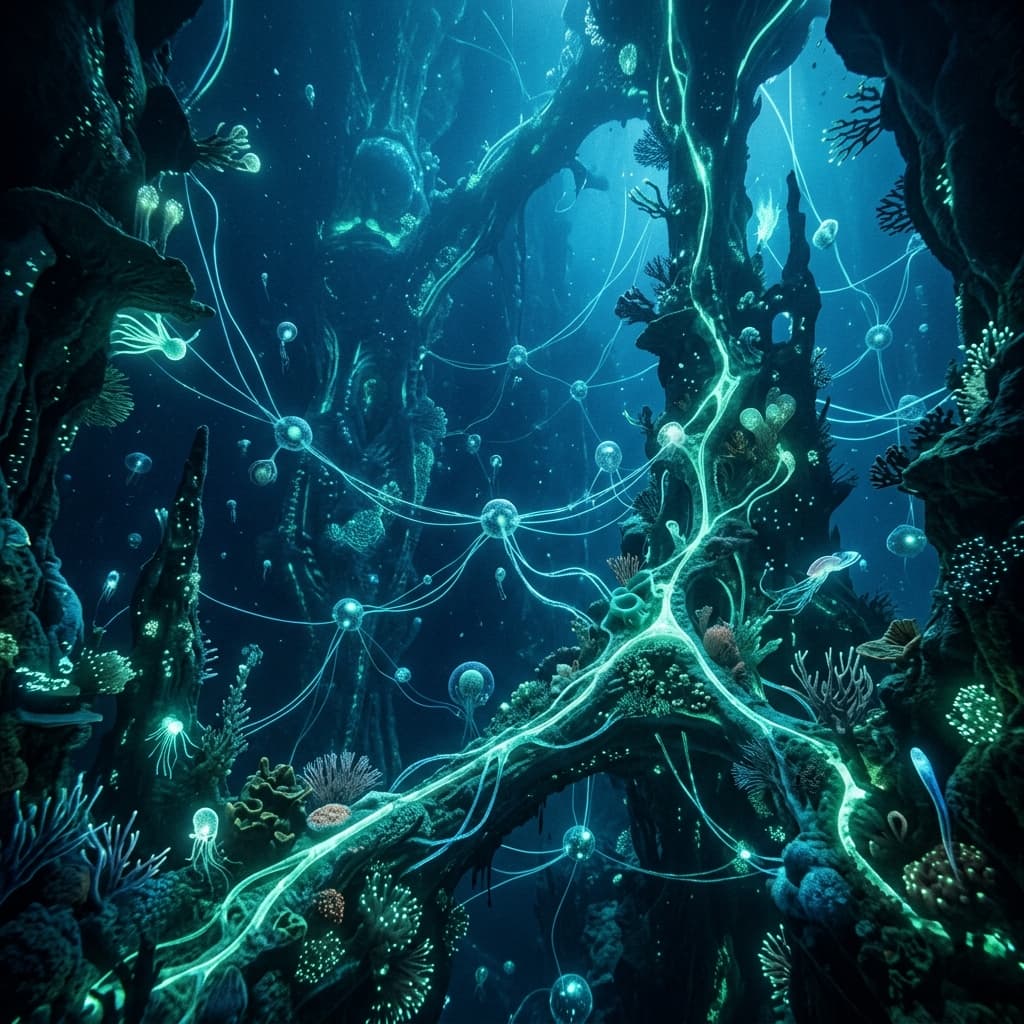
Pelari Biological Gravitic Systems (PBGS) are not discrete engineered units. They are distributed ecological systems — networks of purpose-developed organisms whose collective behavior produces gravitic equilibrium effects at scales determined by the size and synchronization density of the network. Individual organisms range from sessile anchor structures embedded in hydrosphere foundations to mobile regulation organisms distributed throughout large fluid environments.
No single organism constitutes a complete gravitic system; the functional unit is always the network. PBGS systems draw on continuous nutrient circulation, mineral replenishment, and stable environmental chemistry rather than fusion or electrical infrastructure. Large hydrosphere gravitic networks are among the most resource-intensive biological structures maintained by the Pelari, requiring dedicated internal ecosystem support for sustained operation.
Operational Environment: High-pressure aquatic environments, orbital biological structures, bioship interiors, and low-gravity deep-space habitats. Performance degrades significantly outside stable aquatic or pressure-regulated conditions.
Biological Coupling Principles
Capabilities: PBGS networks create controlled localized gravitic counterforces and equilibrium stabilization fields. They reduce effective load interaction with local gravity, stabilize suspended fluid masses, moderate inertial stress on biological structures, regulate internal pressure gradients, and maintain orientation coherence across large aquatic environments.
At full hydrosphere scale, coordinated PBGS networks sustain ocean cohesion, regulate internal circulation, distribute thermal loads, and prevent structural drift. The scaling effect is emergent — it arises from synchronized distributed biology rather than from high-output individual organs, producing stabilization capabilities greater than component parts suggest.
Limitations: PBGS systems are optimized for long-duration equilibrium maintenance rather than rapid force response. They respond slowly to sudden acceleration and perform poorly in environments requiring fast tactical gravitic adjustment. They cannot generate the high-authority field output of Terran CGFS installations, and their biological dependence on stable aquatic chemistry, continuous nutrient supply, and long maturation cycles makes them vulnerable to environmental disruption. Damage recovery requires biological regrowth measured in years or decades. The systems are not suited to the hard-vector, high-authority gravity environments characteristic of Terran military vessels.
Underlying Principles: Pelari gravitic biology operates within the same universal graviton physics understood by Terran science. Specialized biological tissues synchronize internal oscillatory behavior across mineral-organic conductive structures, crystalline biomatrices, electrochemical coordination networks, dense gravimass inclusions, and distributed resonance tissues. When synchronized at sufficient scale, these tissues produce coherent coupling with local graviton-mediated curvature fields — weakly influencing local curvature equilibrium, redistributing force interaction, and moderating inertial stress.Distinction from Terran Gravitic Engineering: Terran CGFS installations generate active graviton fields and impose engineered curvature through high-energy projection systems. PBGS networks couple to existing curvature environments and redistribute force interaction biologically, stabilizing equilibrium states through adaptive low-authority modulation. The distinction is substantial both technically and in terms of the physical intuitions that underlie each approach. Terran gravimetric instruments can measure PBGS field effects but do not yet model the biological coupling mechanism with precision.
directed bioengineering history
Native Environment Naluum'thar: Pelari gravitic biology originated on Naluum'thar, a high-pressure oceanic world shaped by extreme deep-ocean pressure gradients, strong tidal interaction, complex planetary current systems, large-scale fluid instability zones, and resonance-active trench environments. Naturally occurring IM-9-adjacent anomalies in several deep-trench regions may have contributed additional selective pressure. The environment consistently favored organisms capable of maintaining stable orientation, pressure equilibrium, and buoyancy regulation under constantly shifting fluid forces.
Primitive Gravitic Sensitivity: The earliest precursor organisms possessed no meaningful gravitic control. Certain deep-ocean lineages developed extremely weak interactions with local graviton-mediated curvature behavior — effects subtle enough that they would have produced only marginal advantages in buoyancy regulation, orientation stability, and tissue stress reduction during tidal shifts. Current Pelari bioengineering records suggest these primitive traits were so minor as to be imperceptible outside sensitive biological measurement.
Directed Bioengineering: Modern Pelari gravitic biology is primarily the product of long-duration deliberate bioengineering rather than natural selection. After developing advanced biological manipulation techniques, early Pelari researchers identified several native organisms with measurable gravitic-coupling traits and began selectively amplifying them.
Over thousands of cycles, Pelari bioengineering programs enhanced gravitic sensitivity tissues, increased synchronization behavior between organisms, introduced mineral-organic conductive structures, strengthened coherent coupling response, developed large distributed equilibrium organisms, and constructed biologically networked stabilization systems. What began as minor adaptive traits became the infrastructure of a civilization.
The first engineered gravitic organisms were applied to pressure stabilization, reef anchoring, deep-ocean habitat support, current regulation, and large-scale buoyancy management. Increasingly sophisticated biological systems followed, producing the Core Gravimass Clusters, Perimeter Gravity Webs, Pressure Gradient Sacs, Directional Gravity Tubules, and Tide Heart structures.
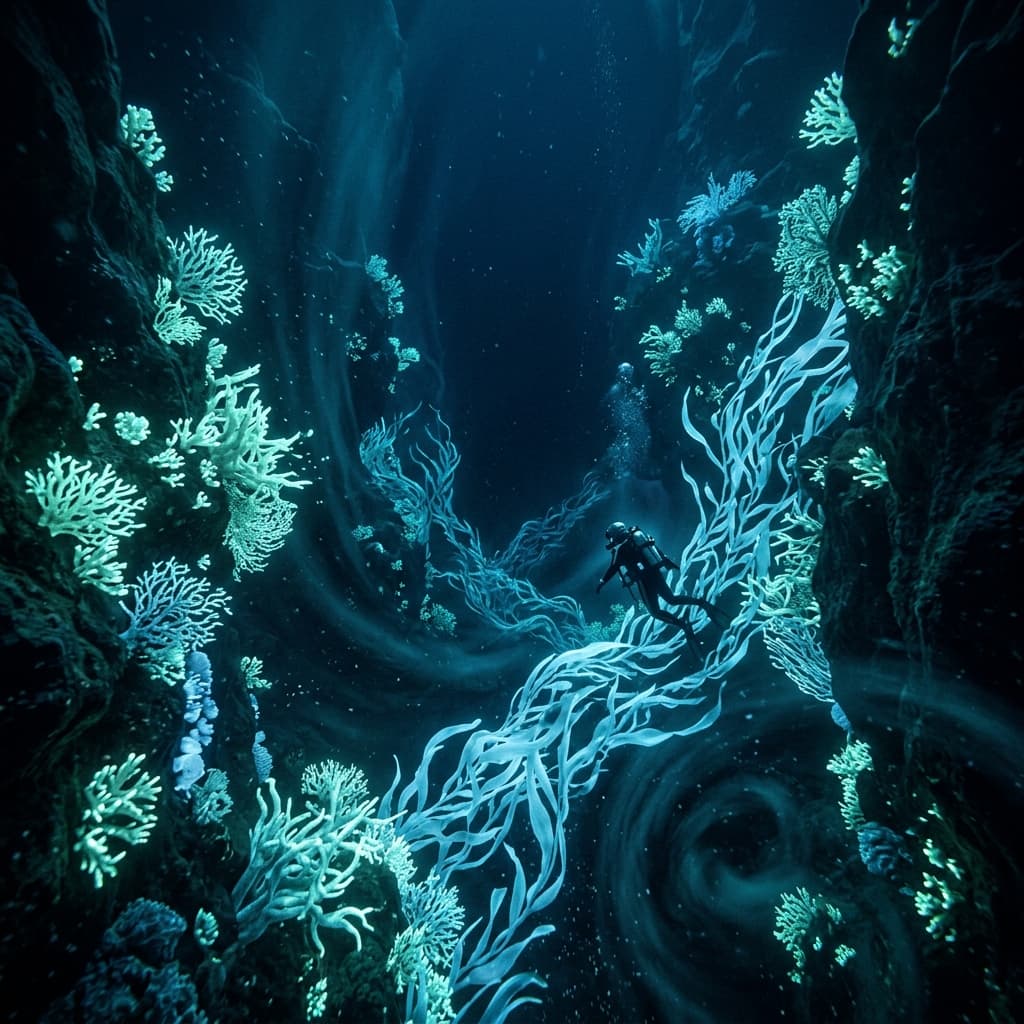
Living Stabilization Nodes
Core Gravimass Clusters
Anchor organs of large Pelari gravitic networks, embedded in foundations to provide structural anchoring and long-duration inertial stabilization.
Core Gravimass Clusters: The anchor organs of large Pelari gravitic networks. They contain dense concentrations of mineral-rich tissues, gravimass inclusions, crystalline conductive matrices, and highly synchronized coupling tissues — the highest-density gravitic biology found in any known Pelari organism. In operational hydrospheres, they are embedded in foundation structures and deep internal positions, where they provide structural anchoring, large-scale equilibrium stabilization, and long-duration inertial moderation. They are metabolically expensive, slow to respond to dynamic changes, and require years to decades to regrow after significant damage — but their output is stable enough to form the gravitational backbone of large Pelari hydrospheres.
Perimeter Gravity Webs: Distributed gravitic stabilization tissues embedded throughout the outer surfaces and structural boundary regions of large Pelari biological installations. They regulate surface equilibrium, reduce fluid drift at structural margins, moderate tidal stress, stabilize orientation across wide areas, and distribute force loads away from structurally sensitive regions. Perimeter Gravity Webs handle the dynamic regulation that Core Gravimass Clusters cannot — fast-responding and distributed where the core structures are slow and centralized.
Pressure Gradient Sacs: Adaptive pressure-management organs distributed throughout Pelari habitat structures. They regulate internal pressure layering, fluid-density gradients, environmental circulation, inertial stress distribution, and shock moderation. Their primary function is preventing the steep pressure differentials that would otherwise develop across large fluid masses in orbital or low-gravity environments. Pelari habitat stability under non-planetary gravity conditions depends heavily on healthy Pressure Gradient Sac networks.
Directional Gravity Tubules: Distributed gravitic routing tissues — semi-fluid conductive biological structures that guide coupling behavior, coordinate force redistribution across large networks, synchronize local equilibrium response, and route inertial moderation through the structural geometry of large installations. Tubules carry gravitic signal rather than fluid or electrical impulse, and their conduction mechanism is not yet fully characterized by Terran instruments. They are the connective tissue of PBGS networks, and their condition is a reliable indicator of overall network health.
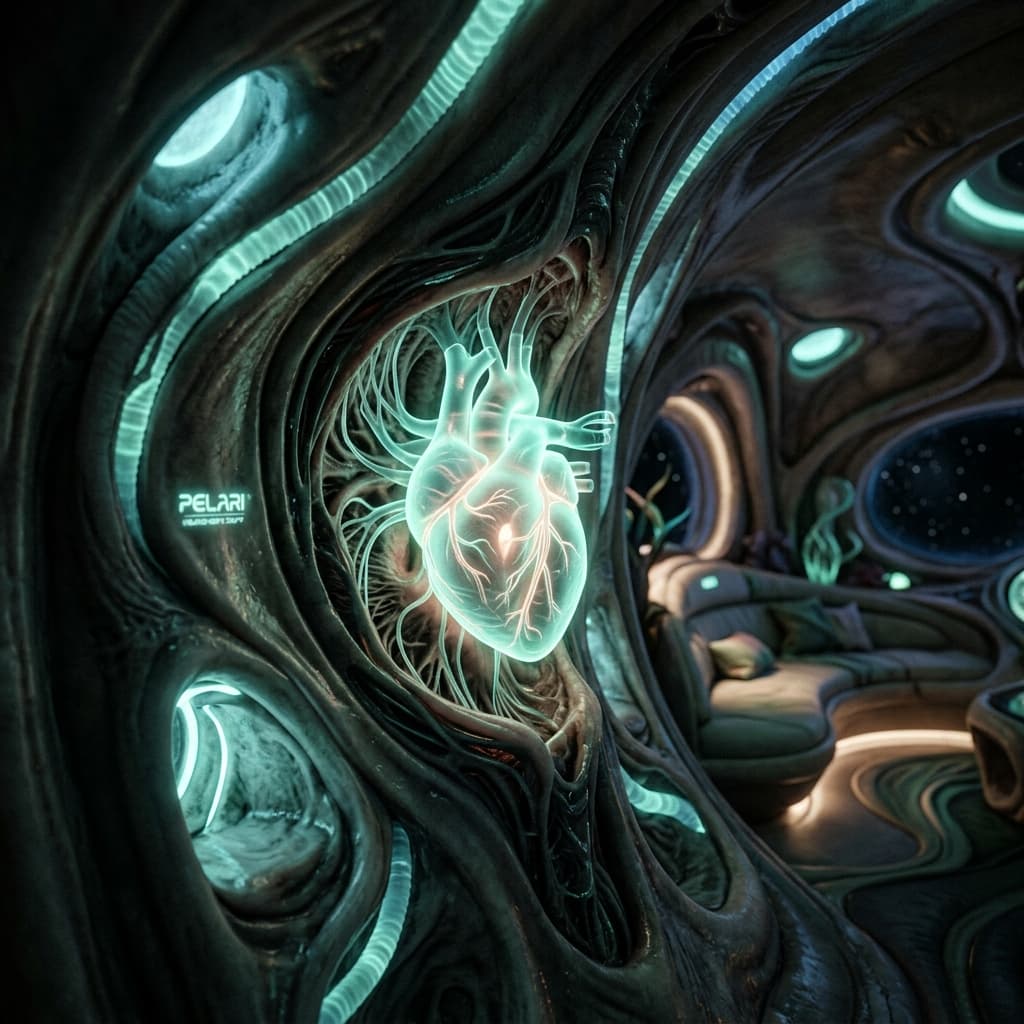
Tide Heart Structures: Compact integrated gravitic equilibrium organs used aboard bioships and mobile Pelari biological infrastructure. Where hydrosphere systems rely on large, slow-responding anchor structures networked across enormous areas, bioships require rapid equilibrium response in a constrained volume. Tide Hearts coordinate local orientation, pressure balance, internal fluid stability, maneuver stress moderation, and habitat cohesion during transit — producing the adaptive equilibrium environment that Pelari and their guests experience aboard bioships.
Ecological Infrastructure
Hydrosphere Stabilization: Pelari hydrospheres cohesion emerges from the combined effect of structural self-mass, Core Gravimass Cluster anchoring, distributed Perimeter Gravity Web regulation, Pressure Gradient Sac management, and continuous biological equilibrium maintenance. The biological systems stabilize and shape existing gravitational behavior rather than generating an independent gravity well. PBGS networks can sustain hydrosphere cohesion across centuries of continuous operation, but damage to core anchor structures initiates degradation sequences that mechanical repair cannot arrest. Biological recovery governs the recovery timeline regardless of available Terran technical assistance.
Bioship Equilibrium: Pelari bioship interiors produce adaptive equilibrium environments with soft directional bias rather than the hard-vector deck gravity of Terran vessels. Tide Heart networks adjust continuously to maneuver stress, maintaining fluid stability and habitat orientation through biological response rather than field-geometry programming. The resulting environment is experienced by Terran visitors as "water-stable" — a persistent soft directional sensation without the sharp down-vector of Terran artificial gravity. Vestibular adaptation periods are common among Terran personnel newly assigned to extended bioship duty.
Deep-Ocean and Orbital Infrastructure: Beyond hydrospheres and bioships, PBGS biology underpins Pelari deep-ocean habitat networks, orbital biological structures, and reef-based megastructure foundations. In all these contexts, the same biological principles apply at different scales — distributed anchor structures, perimeter stabilization networks, and pressure management organs working in coordination to sustain environments.
Terran–Pelari Interface
Terran and Pelari gravitic systems produce incompatible environmental conditions for occupants. Hard-vector versus adaptive equilibrium orientation, mechanical versus biological response timing, fixed field geometry versus distributed fluid regulation, and different inertial compensation behavior collectively produce disorientation and vestibular stress when personnel move between the two environments. Joint Terran–Pelari habitats established under the Tri-Species Compact research access framework require intermediary environmental layers — transition zones with graduated field adjustment — to prevent occupant discomfort.
Direct technical integration of Terran CGFS hardware and Pelari PBGS biology has not been achieved. The two systems operate through different physical mechanisms at different authority levels, and the biological coupling behavior of PBGS tissues does not respond predictably to the engineered field geometry of CGFS emitters. Joint research programs are investigating interface architectures, but practical hybrid systems remain in early development.
Phase | Duration | Indications & Protocols |
|---|---|---|
| Initial Orientation | 2–7 Days | Vestibular adaptation period. Soft directional shifts occur. |
| Stability Baseline | 8–10 Days | Vestibular sensors stabilize. Natural water-stable baseline. |
| Adaptation Assessment | 10+ Days | Assessment required if vestibular failures persist. No long-term harm. |
Strategic & Diplomatic Stewardship
Military Implications: PBGS systems have no meaningful offensive application. Their low field authority, slow response time, aquatic optimization, and biological dependence make them unsuitable for combat contexts. However, PBGS biology provides passive structural resilience to Pelari habitats and vessels that Terran instruments characterize as difficult to model. Damage to hydrosphere gravitic networks does not produce immediate catastrophic failure — the distributed architecture absorbs localized disruption and degrades gradually, buying time for biological response.Research Value: PBGS biology offers a distinct evolutionary and engineering pathway to graviton-mediated environmental control, one that Terran researchers working in large-scale orbital construction and megastructure stabilization have begun treating as a productive reference point for distributed biological equilibrium principles that could complement SGSG-class Terran mechanical systems.
Diplomatic Considerations: Pelari bioengineering lineages retain full stewardship authority over all PBGS biology. Access for Terran research purposes is governed by the Tri-Species Compact scientific access provisions and requires Concord acknowledgment. The Pelari do not license or transfer biological gravitic systems as technology — organisms are not equipment, and Pelari stewardship frameworks do not recognize the distinction between biological infrastructure and living entities.
Xenobiological Stewardship Standards
Physical Risks to Terran Personnel: Pelari gravitic environments are not hazardous to Terran visitors under normal conditions. The soft directional bias of bioship environments and the gentle pressure gradients of hydrosphere transitional zones produce vestibular adaptation effects rather than injury. Proximity to damaged or destabilized PBGS biology — particularly large Core Gravimass Cluster failure events — may produce localized gravitic instability with physical consequences for personnel in affected zones.Environmental Risks: PBGS biology is itself the environment in Pelari habitats. Terran interventions that disrupt gravitic biology — including mechanical damage to network structures, introduction of incompatible chemical environments, or electromagnetic interference with electrochemical signaling — carry significant ecological risk and are governed by Tri-Species Compact research protocols.Research Ethics: Terran study of PBGS biology is conducted under Concord-acknowledged research access provisions. Sampling, physical manipulation, or modification of living PBGS organisms requires explicit Pelari bioengineering lineage consent. Pelari Biological Gravitic Systems at current operational tiers are not evaluated under Terran threshold science frameworks; they constitute Pelari biological heritage.
Active joint research programs between Terran and Pelari researchers are investigating improved biological-mechanical gravitic interfaces, distributed adaptive stabilization systems applicable to Terran megastructure construction, hybrid equilibrium architectures for long-duration joint habitats, biological inertial moderation systems relevant to Commonwealth medical programs, and high-precision surgical gravitic biomaterials.
Pelari researchers have expressed interest in Terran gravimetric sensor technology as a tool for monitoring PBGS network health at greater precision than existing Pelari biological sensing methods allow. Progress on direct PBGS-CGFS integration architectures is slow; the mechanistic gap between biological coupling and engineered field projection has not yet been bridged at a practical level.
Associations & History
Controlled Graviton Fields (CGFS)
[TECH]Terran high-authority counterpart technology.
Elurath Bioship Systems
[TECH]Related Pelari biological engineering infrastructure.
Pelari Symbiotica Species Profile
[SPE]Biological and governance profile of the Pelari.