POLAR MAGNETO
SPHERE
TECHNOLOGY OVERVIEW
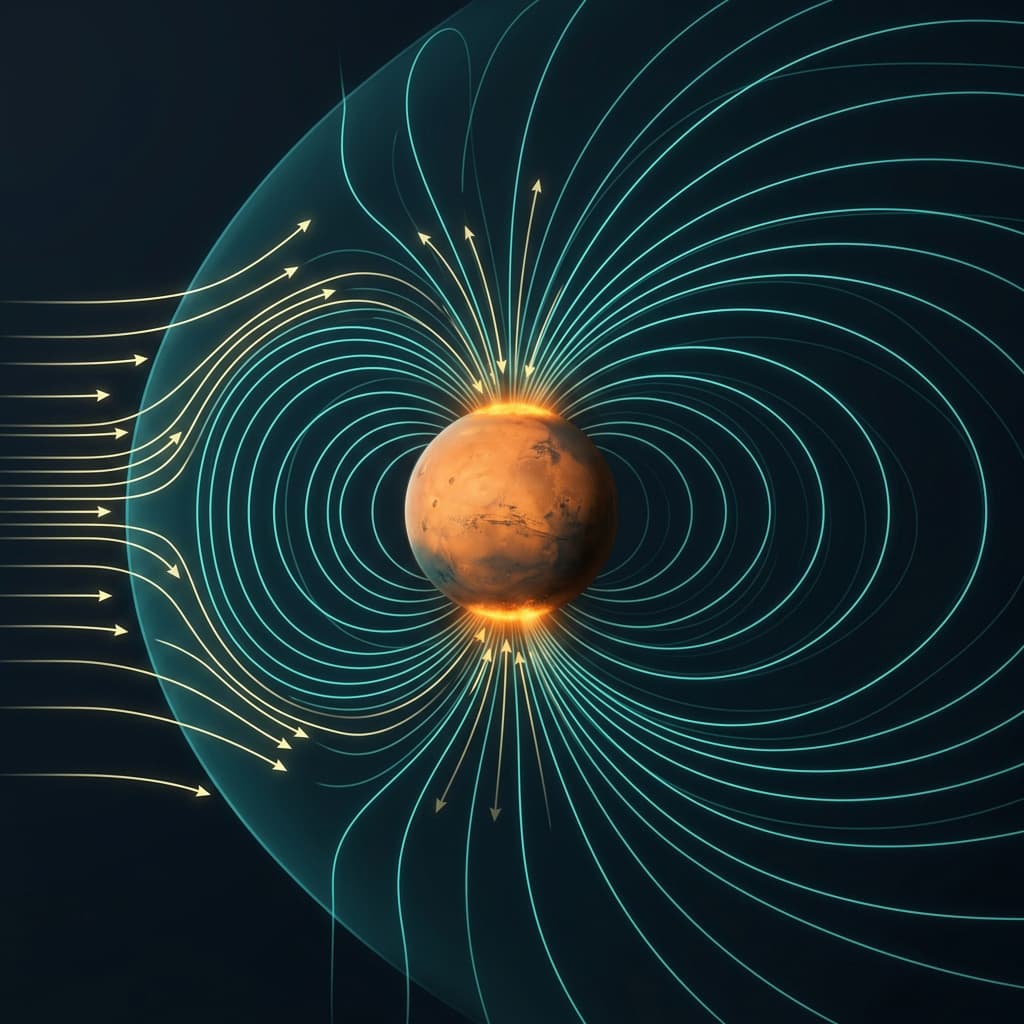
Mars lacks a planetary magnetic field sufficient to deflect the solar wind. Without intervention, the solar wind erodes the upper atmosphere, stripping volatiles essential to the terraforming program and exposing the surface to elevated particle radiation.
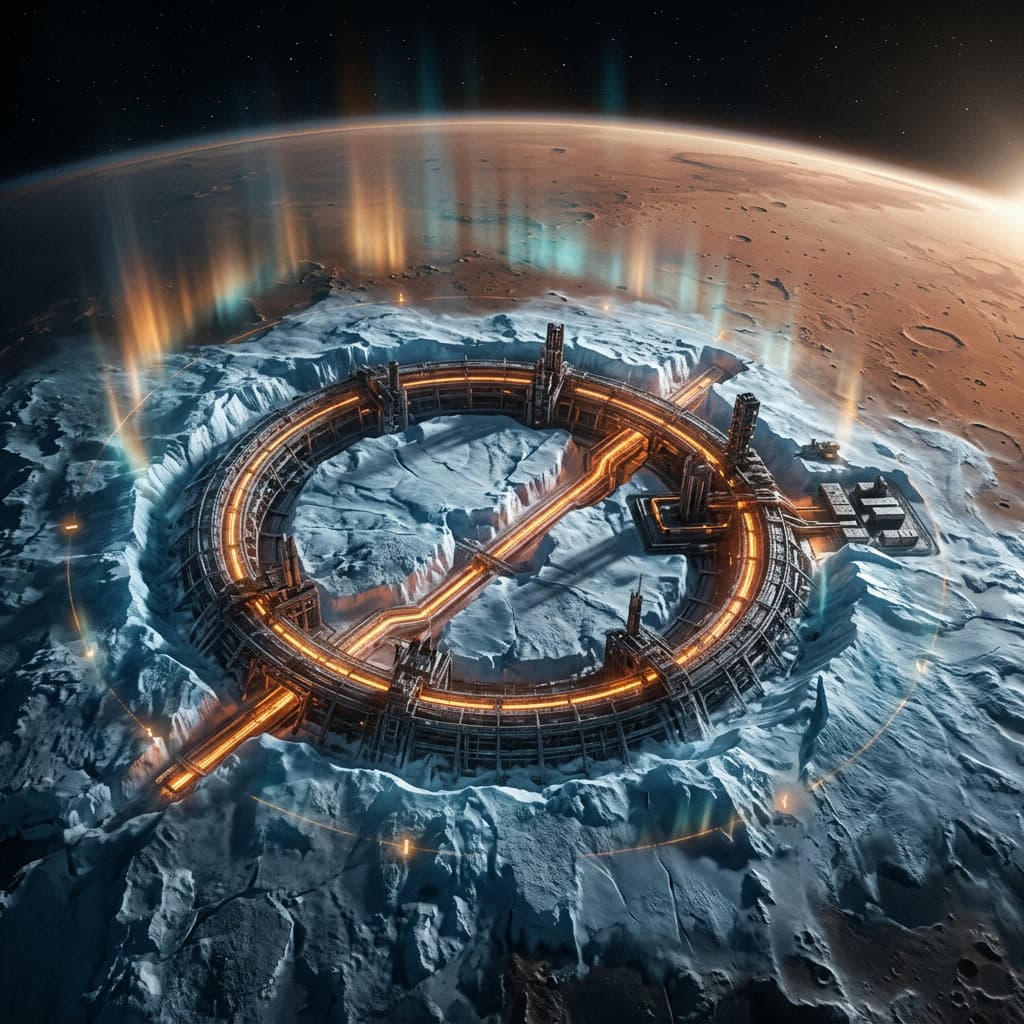
The PMGS generates an artificial dipole magnetic field from paired generator installations at the Martian poles, sufficient to deflect the bulk of the solar wind and reduce surface radiation to levels comparable to Earth's mid-latitudes.
The system does not replicate a planetary core dynamo; it is a surface-anchored electromagnetic prosthetic that performs the same shielding function by different means.
TECHNICAL SPECIFICATIONS
THEORETICAL BASIS
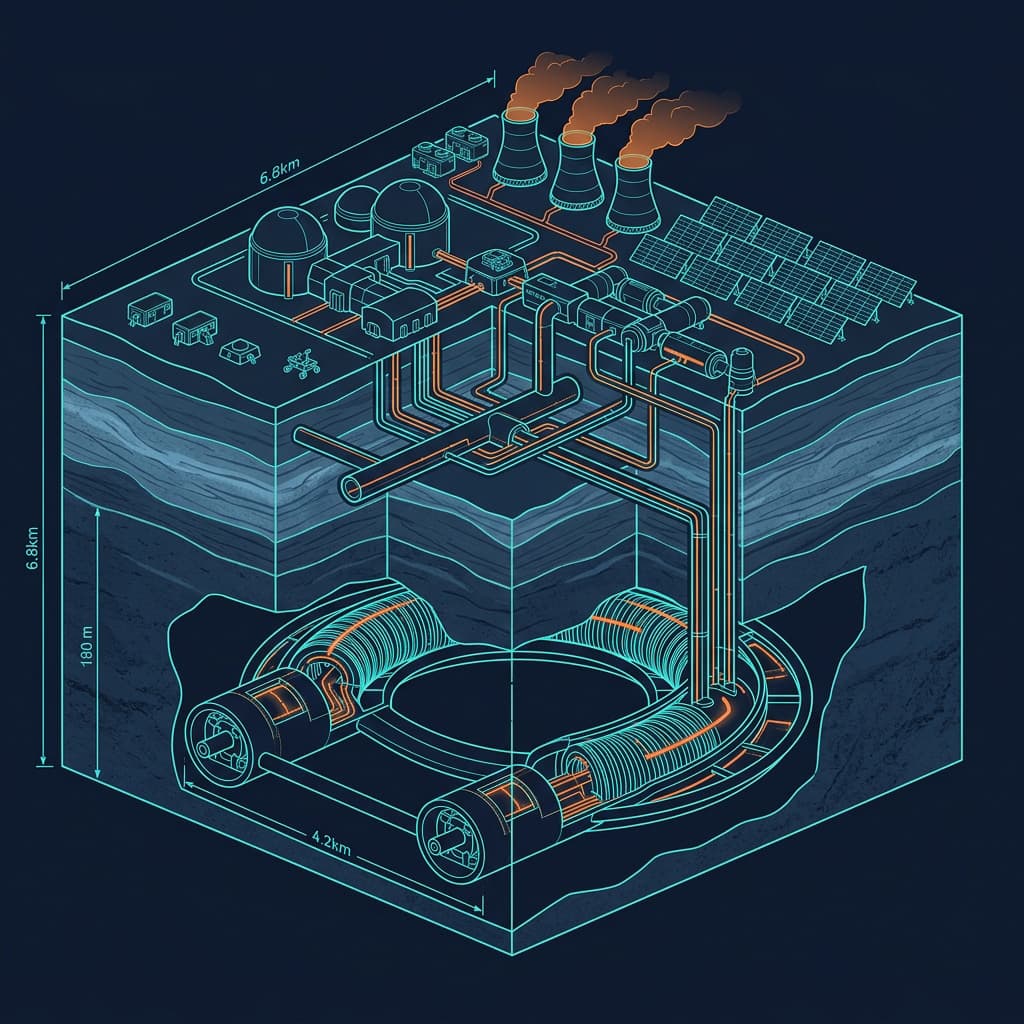
The PMGS operates on the same electromagnetic principles as any large-scale solenoid: electrical current through a superconducting coil generates a magnetic field proportional to current magnitude and coil geometry. The engineering challenge was not theoretical novelty but scale.
The PMGS relies on high-temperature superconducting materials developed through the Commonwealth advanced materials program in the 24th century, maintained at operating temperature by closed-loop cryogenic systems driven by dedicated thermal management reactors.
The field geometry — a north-primary, south-secondary asymmetric dipole — was a deliberate design choice. A perfectly symmetric dipole would produce identical exclusion zones at both poles; the asymmetric configuration concentrates particle convergence preferentially at the north pole, where the smaller polar cap and the Planum Boreum geology were better suited to an exclusion zone.
POLAR EXCLUSION ZONES
The PMGS field geometry produces a consequence that has no practical solution within current engineering constraints. A planetary magnetic field deflects incoming charged particles toward the magnetic poles — the same mechanism that produces Earth's auroras.
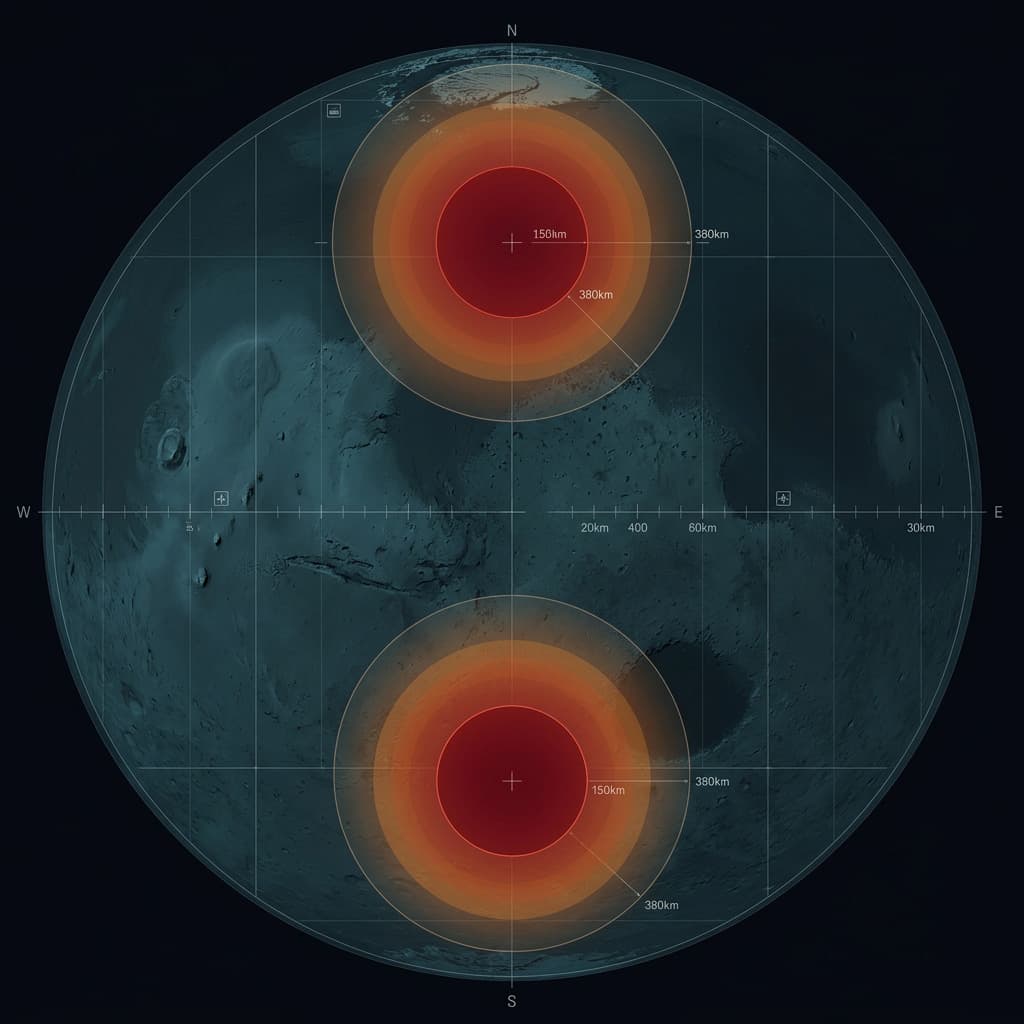
On Mars, the PMGS field is a surface-anchored emitter rather than a deep-core dynamo, and the convergence zone reaches the surface in a roughly circular region surrounding each generator installation.
Within approximately 380 kilometers of each pole, solar wind particles directed by the field lines arrive at the surface in sustained, high-flux streams. The zones are not uniform — flux is highest within 150 kilometers of the generator installations and attenuates toward the 380-kilometer boundary.
These Polar Exclusion Zones are a permanent feature of PMGS operation. They cannot be eliminated without either relocating the generators off the surface (presently beyond engineering capability) or accepting reduced shielding across the rest of the planet.
Personnel operate under strict dosimetry protocols. Rotation schedules limit cumulative annual exposure. No permanent residency is permitted within the zones; generator installations are staffed on 90-day maximum rotations.
PERFORMANCE & MAINTENANCE
CAPABILITIES & LIMITATIONS
ANNUAL MAINTENANCE
Once per Martian year (approximately 687 Earth days), the PMGS undergoes a scheduled 14-hour recalibration window during which sections of the primary coil arrays are sequentially cycled down for diagnostic testing, thermal management system inspection, and superconducting coil verification.
During the maintenance window, the planetary field is reduced to approximately 60% of nominal strength for up to 6 hours at maximum drawdown. Surface radiation rises to approximately 4–5× Earth baseline during this period.
All surface personnel not in shielded facilities return indoors or to subsurface environments. Orbital operations above 200 km altitude are suspended. No launch windows are scheduled during the window.
The maintenance window has been observed without incident for all 185 completed Martian years of PMGS operation.
DEVELOPMENT HISTORY
STRATEGIC ASSESSMENT
MILITARY
Offensive Potential: None in conventional operation. The exclusion zones create a radiation environment that could theoretically be exploited defensively, but this is an incidental characteristic rather than a designed capability.
Defensive Value: The PMGS is critical infrastructure. Its destruction would initiate atmospheric erosion on a timescale of decades and immediately elevate surface radiation to pre-terraforming levels, forcing population to subsurface environments.
Strategic Impact: The PMGS is the single piece of infrastructure whose loss would be most damaging to Martian habitability on a short timescale. Warp drive production could be relocated; the PMGS cannot be substituted.
ECONOMIC
Development Cost: Approximately 8.7 trillion Commonwealth credits across 260 years of research, construction, and initial operation — the single largest investment in Martian terraforming infrastructure.
Operational Cost: Approximately 340 billion credits annually (power, personnel, maintenance); funded through Martian planetary budget with 15% UTC subsidy.
Economic Benefit: Without the PMGS, the entire Martian surface industrial economy would be confined to subsurface environments, reducing habitable and operational surface area by an estimated 60%. The system's contribution to Mars's economic output is effectively incalculable.
DIPLOMATIC
Allied Species Access: PMGS design documentation is not classified. Pelari and Chorus representatives have reviewed technical documentation at their request; neither has expressed interest in application. The Pelari noted academic interest in the superconducting materials science.
Treaty Implications: The PMGS generates no electromagnetic interference with agreed-upon communication frequencies. No treaty complications on record.
Proliferation Risk: Minimal. The technology is exclusively applicable to large, airless or thin-atmosphere planetary bodies and requires massive infrastructure investment.
SAFETY & OPERATIONAL DOCTRINE
HAZARD & ETHICS
The polar exclusion zones are the primary ongoing physical hazard. Personnel entering without adequate dosimetry monitoring and rotation scheduling face cumulative radiation exposure above safe career limits.
All deaths attributable to PMGS-related radiation exposure (7 confirmed cases since 2601 CE, all prior to 2720 CE protocol standardization) resulted from protocol violations rather than system malfunction.
The PMGS field has no documented adverse effects on Martian surface ecology, introduced organisms, or equipment outside the exclusion zones.
Threshold Science Evaluation: The PMGS involves no novel physics; it is a scaled application of established electromagnetic principles. No Kordahl concerns identified.
Usage Restrictions: The exclusion zones are permanently designated as restricted access. Entry requires Infrastructure Authority clearance, radiation dosimetry equipment, and documented rotation compliance.
Oversight: The Martian Planetary Council Infrastructure Authority maintains continuous operational oversight. Annual performance reports are submitted to the UTC Senate Terraforming Oversight Committee.
ACCIDENT SCENARIOS
OPERATIONAL DOCTRINE
FUTURE DEVELOPMENT
ENHANCEMENT
Research at the Kordahl Institute is investigating whether advances in high-temperature superconducting materials could allow a reduction in exclusion zone radius by increasing field efficiency at equivalent power draw.
Preliminary modeling suggests that a 15–25% reduction in exclusion zone radius may be achievable with next-generation coil materials; this would not eliminate the zones but would reduce restricted area by approximately 130,000 km².
RELATED RESEARCH
A longer-term research program is investigating whether orbital field-augmentation emitters — high-altitude satellites contributing a supplementary field component — could reduce the surface convergence flux in exclusion zones without reducing total planetary shielding. This approach is considered speculative at current technology levels but is identified as the most plausible path toward eventual exclusion zone elimination.
The advanced superconducting materials science developed for PMGS coil assemblies has contributed to Commonwealth computing and power transmission infrastructure broadly. The PMGS materials program is credited with accelerating Commonwealth superconducting technology by an estimated 40–60 years.
LONG-TERM OUTLOOK
The PMGS is expected to remain necessary for the duration of Martian human habitation. Mars's geological core has cooled beyond any prospect of natural magnetic field regeneration on timescales relevant to civilization.
No post-PMGS scenario has been modeled or planned. The system is, in the most literal sense, permanent infrastructure.