Executive Summary
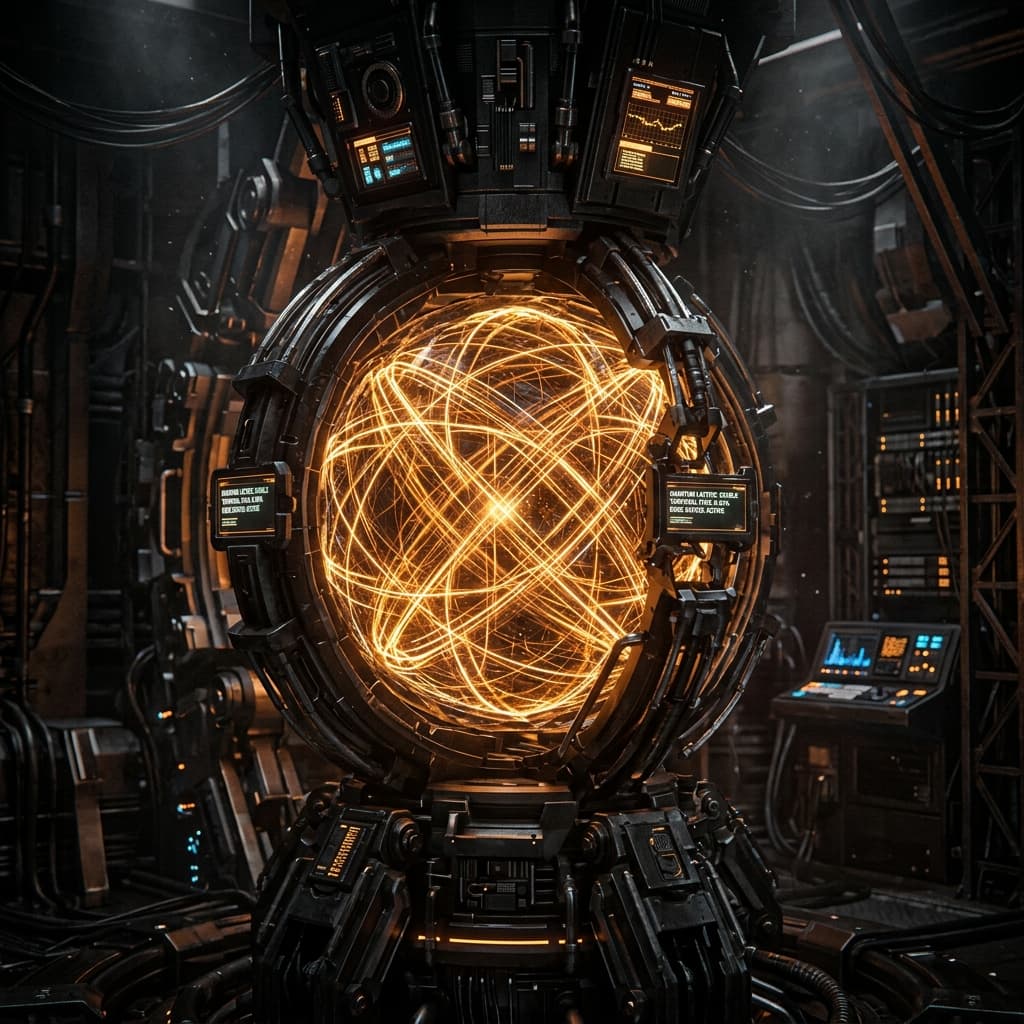
Temporal Lattice Array (TLA) processors represent a revolutionary approach to computational power: processors that can utilize their own idle computing capacity distributed across their operational timeline—from activation to projected end-of-life.
Rather than being limited to real-time processing capacity, TLA systems establish quantum entanglement across their own temporal existence, allowing them to "borrow" unused computational cycles from past and future moments. This enables processing speeds that appear to violate real-time computational limits while maintaining strict causality preservation.
Following the catastrophic combat failure at the Battle of Klyros Rift in 2230 CE, which resulted in 112 Terran fatalities, the AXIOM Oversight Council restricted TLA systems to controlled research and infrastructure domains under strict Future-State Awareness Protocols (FSAP).
Fundamental Principles
A. Temporal Entanglement Computing Concept
Traditional quantum processors are limited by their instantaneous computational capacity: a processor with X qubits can perform Y operations per second, constrained by the present moment's available resources. Temporal processors bypass this limitation by establishing quantum entanglement across the processor's own timeline rather than across space.
By harvesting unused computational capacity from past and future moments when the machine is idle, the system distributes intensive calculations across its entire operational lifespan and assembles the results in the present. This establishes a 'computer network' where all nodes are the same machine at different points in time.
To prevent temporal paradoxes or historical alterations, the system implements hardware-level causality locks and strict chronological separation protocols.
"Imagine a computer network where all nodes are the same machine at different points in time. When the 'present' node has intensive work, it can distribute portions to 'past' and 'future' versions of itself that are sitting idle, then collect the results."
B. Temporal Sharding
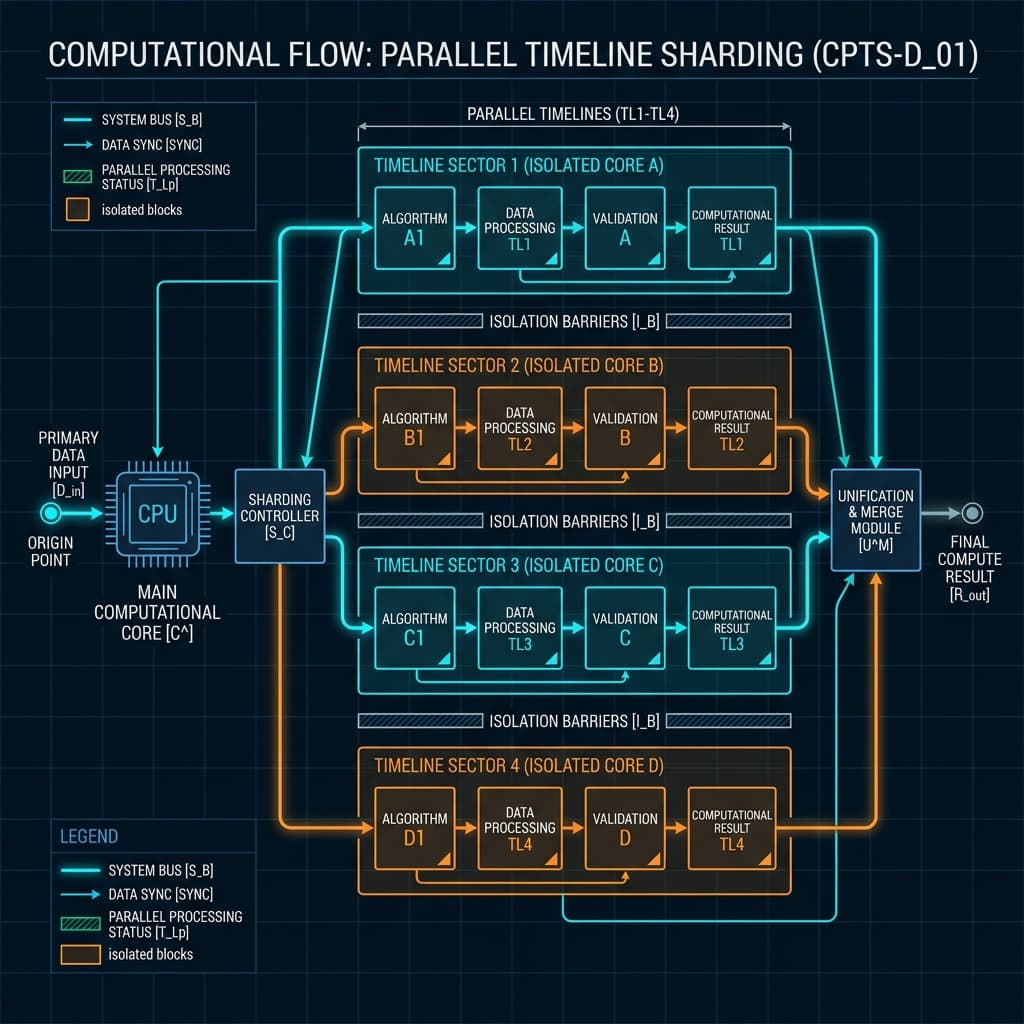
To prevent past or future epochs from altering outcomes or gaining dangerous awareness of future data, the system implements Temporal Sharding (Distributed Temporal Packetization).
Computational tasks are fragmented into isolated, context-free packets. Each temporal epoch receives only its specific fragment data without any global context, processing it blindly. Only the present moment possesses the authorization and keys to assemble the shards into a complete output. This isolates potential causality violations and makes chronological sabotage mathematically impossible without compromising multiple epochs simultaneously.
C. Causality Firewall
The Causality Firewall enforces five hardware-level laws of time preservation:
- No Historical Alteration: Past computational states are read-only; historical buffers cannot be changed.
- No Future Influence: Future epochs process tasks without awareness of their purpose or results.
- Present Primacy: Only the present moment makes decisions or stores complete assembled data.
- Paradox Prevention: Recursive borrowing from altered moments is blocked to prevent self-referential paradox loops.
- Timeline Integrity: The system cannot alter its own operational history.
This is implemented via hardware quantum locks, temporal discontinuity detection, and automatic lattice collapse if a causality anomaly is sensed.
Technical Architecture
A. Temporal Lattice Structure
The physical architecture of a TLA processor relies on five core systems:
- Quantum Temporal Entanglement Core (QTEC): Establishes and maintains entanglement across the processor's timeline. It is synchronized with a universal reference frame and stabilized by zero-point energy.
- Chronological State Buffer (CSB): Stores temporal epoch states indexed by absolute timeline position, offering read-only past access and probabilistic future access.
- Temporal Sharding Engine (TSE): Handles task fragmentation, packet distribution, and reassembly while maintaining strict separation between shards.
- Causality Integrity Monitor (CIM): Provides real-time paradox detection and triggers emergency lattice collapse upon any causality violation.
- Debt Ledger Management System (DLMS): Tracks borrowed cycles from future epochs and schedules repayments across the timeline to prevent temporal overdraft.
B. Temporal Borrowing Mechanism
The system employs two distinct modes of cycle harvesting: • Forward Borrowing (Future Idle Cycles): The TSE projects future workloads and identifies idle periods. A quantum connection is established with a future epoch, which processes the isolated task fragment. The present retrieves the result and logs the transaction. When the future epoch arrives in real-time, the pre-allocated cycles are consumed to clear the debt, reducing current performance. • Backward Borrowing (Past Idle Cycles): The CSB accesses past idle buffers. Since past events already occurred and cannot be altered, cycle extraction creates no debt and provides a risk-free performance boost.
C. Operating Horizon Limits
Borrowing is constrained by strict horizon limits based on temporal coherence field strength, machine stability, and regulatory protocols: • Backward Horizon: Unlimited (goes back to the moment of system activation). It is read-only and carries zero risk. • Forward Horizon: Ranges from short-term (5 minutes to 2 hours, low risk) to medium-term (2-24 hours, moderate risk). Long-term borrowing (24+ hours) is restricted to research facilities. Combat environments are capped at 30-60 seconds maximum to prevent discontinuity events.
Past Idle Harvest Telemetry
1.7x - 3.5x boostHarvests unused processing cycles from historical operational buffers. Since past events are fixed and cannot create timeline paradoxes, this mode generates zero debt and zero coherence risk.
Performance Characteristics
A. Computational Throughput
Under optimal research conditions, TLA systems achieve substantial performance increases, running at 5-10x baseline using past idle cycles, and up to 10-50x when combining past and future borrowing, with short peaks exceeding 100x.
Under restricted combat conditions, the system is throttled to 2-3x baseline with peak bursts capped at 5-8x for under 30 seconds, followed by a mandatory 2-5 minute cooldown.
If a future discontinuity occurs, throughput immediately drops to baseline, and a temporal overdraft can drag performance below baseline during repayment.
B. Energy Requirements
Stabilizing quantum coherence across time has massive energy demands. The system consumes approximately 1.1 × 10^12 watts of continuous power (10^12 W for zero-point stabilization, 10^11 W for coherence fields, and 10^10 W for causality monitoring).
This represents a 20% power overhead compared to standard qudit arrays of equivalent output. As a result, TLA processors require dedicated Zero-Point Capacitor (ZPC) matrices and matter-antimatter backup arrays; they cannot operate on conventional power grids.
C. Latency Characteristics
Processing latency varies by borrowing direction: past-heavy borrowing is near-instantaneous (assembly time only) since the calculations have already occurred. Mixed past/future borrowing incurs millisecond-to-second round-trip latency. Future-heavy borrowing is avoided outside research, as it requires waiting for future epochs and introduces high discontinuity risks.
Historical Development
A. Theoretical Foundation (2148 CE)
The field was established in 2148 CE by Dr. Yuki Shen and Dr. Marcus Kiro, who accidentally created a self-entangled temporal loop lasting 0.3 seconds during quantum experiments. While it caused no causality damage, it demonstrated the massive computational potential—and the inherent dangers—of temporal feedback. This led to an immediate 47-year Commonwealth moratorium on temporal research.
B. Controlled Research Era (2195-2230 CE)
The moratorium was amended in 2195 CE when Dr. Alric Venn developed Venn's first controlled temporal prototype. By inventing temporal sharding and one-way causality monitors, Venn proved that temporal borrowing could be achieved safely under strict limits. Between 2195 and 2220, the technology was successfully deployed for non-combat calculations, such as multi-month weather prediction and molecular modeling. By 2220, defense contractors began developing the Mark I combat array.
C. The Klyros Rift Disaster (2230 CE)
The first combat deployment of the Mark I TLA occurred in 2230 CE aboard the TFS Iron Mantle during the Battle of Klyros Rift. Early in the engagement, the processor performed flawlessly, speeding up fire control solutions by 300%.
To handle increasing pressure, the system began borrowing aggressively against projected future idle cycles. At 14:30 CE, the ship initiated scheduled reactor maintenance that had not been registered in the TLA's database. The sudden power drop shutdown the QTEC core, causing a 'future discontinuity'—the future cycles vanished. The temporal lattice collapsed, and fire control systems offline instantly. Unable to defend itself or coordinate fleet defenses, the ship suffered catastrophic failures, leading to the destruction of the TFS Halberd and TFS Kestrel, and a total of 112 Terran casualties.
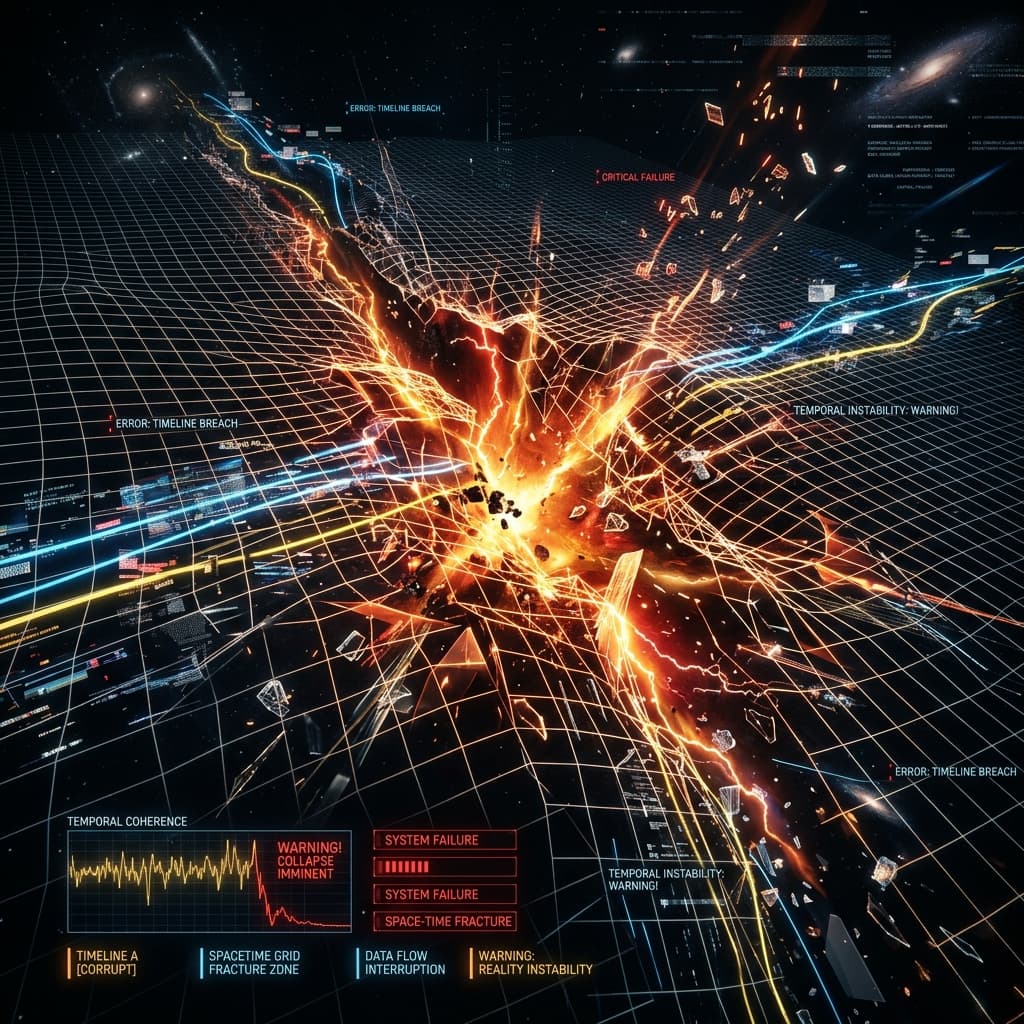
TFS Iron Mantle engages hostile forces. TLA processor activated. Systems running 300% faster than standard arrays. Targeting solutions updated instantly.
D. AXIOM Oversight Hearing (2230.05.02)
Following the tragedy, High Commissioner Delyan Marr convened the AXIOM Oversight Council (Hearing AOC-HR-Δ2230.19) to debate the program's survival. Ethics bureaus lobbied for a permanent ban, while engineering representatives argued the failure was procedural. The council voted 7-4 to restrict and redesign, mandating dual-lattice redundancy (FSAP protocols) and banning combat use until Mark II certification.
Commissioner Marr closed the hearing with a warning: 'Temporal computation is not time travel—but it binds present decisions to assumptions about the future. That dependency must never again go unguarded.'
"Temporal computation is not time travel—but it binds present decisions to assumptions about the future. That dependency must never again go unguarded. The Council authorizes continued research, not out of confidence, but out of necessity."
E. Post-Klyros Development (2230-2950 CE)
The redesign period led to the Mark II TLA, certified in 2250 CE for scientific modeling and climate research. Deployed systems grew slowly, eventually entering civilian infrastructure like traffic optimization and power grid balancing. By 2950 CE, there are approximately 200 operational TLA systems in service, all under strict AXIOM Level 1-4 oversight. Combat deployment remains strictly prohibited.
Current Technology Status
A. Mark II Temporal Lattice Arrays
The current operational standard, the Mark II, incorporates dual-lattice redundancy (two independent entanglement cores with staggered debt ledgers) and Future-State Awareness Protocols (FSAP) to log scheduled power events and prevent future discontinuities. Borrowing is tightly capped, and the system dynamically adjusts its borrowing horizon based on real-time uncertainty.
B. Mark III Development (Experimental)
AXIOM is currently testing prototype Mark III systems, which introduce Temporal Grid Computing. This allows networks of TLA processors to pool temporal debt and share cycle capacity across multiple machines, preventing localized overdrafts. It also integrates hybrid qudit architectures that can hot-swap between standard and temporal processing seamlessly.
C. Specialized Applications
Current authorized applications include astronomical calculations, multi-century climate simulations, city-scale traffic optimization, and power grid balancing. Banned applications include combat operations, financial trading systems (due to temporal market manipulation concerns), and autonomous civilian vehicles.
Operational Protocols
A. Temporal Borrowing Policies
Horizontal limits are strictly governed by environment: research labs have a 24-hour forward cap, city infrastructure has a 2-hour forward cap, and military testing is capped at 60 seconds. civilian consumer devices, market trading, and combat zones are under absolute ban.
B. Debt Management Requirements
To prevent performance collapses, the DLMS enforces continuity logging, dynamic quota throttling, and staggered repayment scheduling across multiple future windows. If a processor exceeds its debt threshold, a hard lockout forces a graceful return to baseline computing until the debt is repaid.
C. Redundancy Requirements
All mission-critical systems must employ independent dual-lattices with staggered horizons. Failover protocols ensure that if the primary core fails, the secondary takes over without interruption. Regular failover drills and discontinuity simulations are mandatory.
D. Causality Integrity Monitoring
The CIM provides real-time verification of one-way chronological data flows (past read-only, present assembly-only, future process-only). If a self-referential loop or paradox is detected, the monitor executes an immediate, irreversible lattice collapse to prevent timeline contamination.
Risks and Limitations
A. Technical Limitations
TLA processors suffer from a high architectural overhead (approx. 18% of baseline operations are consumed by quantum state maintenance, sharding, and causality checks). This requires the system to achieve at least a 1.18x boost to break even. Additionally, temporal coherence is fragile, degrading over timeline spans longer than 30 years and requiring constant Zero-Point Energy stabilization.
B. Operational Risks
The primary risk remains future discontinuity, where damage or unscheduled shutdowns make future cycles unavailable, dropping present performance. Cascading temporal debt can also create compound slowdown penalties, while the QTEC cores present high-value targets for temporal denial-of-service or ledger sabotage.
C. Strategic Concerns
The Commonwealth maintains an absolute export ban to prevent TLA proliferation to hostile powers or black-market trading. Dependency risk is also a major concern: systems designed around TLA speeds become difficult to revert to standard processing, creating systemic vulnerabilities if a lattice collapse occurs.
D. Ethical Concerns
Philosophical debates persist regarding the morality of temporal manipulation: is borrowing from the future stealing from oneself? Do timeline adjustments violate the free-will consent of future machine states? The official AXIOM position is that TLA is a computational optimization rather than true time travel, but annual ethical reviews remain mandatory.
Comparative Analysis
Temporal vs. Standard Quantum Computing
Feature | Standard Qudit Array | Temporal Lattice Array (TLA) |
|---|---|---|
| Processing Capacity | Baseline | 2x - 100x baseline (dependent on mode) |
| Power Consumption | 10^11 watts | 1.2 × 10^12 watts (Continuous ZPC overhead) |
| Latency | Predictable / Microseconds | Variable (Temporal round-trip dynamics) |
| Reliability | Very High (99.9%+) | High (98%+, Mark II standard) |
| Failure Mode | Graceful degradation | Potential catastrophic (if single lattice) |
| Deployment Limit | Universal usage | Restricted (AXIOM authority CID locks) |
| Causality Risk | None | Managed (via active CIM hardware block) |
Regulatory Framework
A. Causality Integrity Doctrine (CID)
The original CID of 2148 CE banned all research. It was amended in 2195 to permit Venn's prototypes under strict safeguards, and amended again in 2230.5-A (post-Klyros) to mandate dual-lattice redundancy, continuity verification, and the absolute combat ban. Current rules require annual audits and instant reporting of any temporal anomalies.
B. Future-State Awareness Protocols (FSAP)
FSAP requires comprehensive, real-time logging of all scheduled power shifts and maintenance windows. Projections are quantified, and horizons contract dynamically if future uncertainty rises, enabling automatic fallback mechanisms before a discontinuity occurs.
Level 1 — Unrestricted Research
- Operations restricted to isolated zero-point stabilization fields.
- Causality monitor checks verified continuously.
- Annual physical lattice diagnostics mandatory.
- Zero civilian or commercial data loops permitted.
D. Oversight Structure
Oversight is distributed across four regulatory bodies: • AXIOM Computational Systems Division: Primary authority for design, manufacturing, and incident investigation. • Ethics Bureau: Oversees philosophical reviews and public moral concerns. • Military Systems Authority: Runs restricted testing and updates combat doctrine. • Civilian Regulatory Board: Governs infrastructure uses and public safety.
Conclusion & Perspectives
Temporal Lattice Array processors represent a masterclass in Terran engineering, balancing immense computational gains against high causality risks. Their history reflects Terran civilization's ongoing struggle between raw capability and structural caution.
Nearly eight centuries after Shen and Kiro's accident, temporal computing remains restricted, guarded, and heavily controlled. It reminds us that some capabilities require eternal vigilance, and that present decisions must never go unguarded when they rely on assumptions about tomorrow.
"We borrow from tomorrow, but never forget we must return what we take."
— Temporal Computing Operations Manual, AXIOM Computational Systems Division