I. Executive Summary
Terran warp drive technology has evolved through three distinct eras: the Dawn of Warp (2250s-2307 CE), the Dark Age of FTL (2307-2638 CE), and the Modern IM-9 Era (2650 CE-Present). Each represents a fundamental leap in capability, safety, and accessibility.
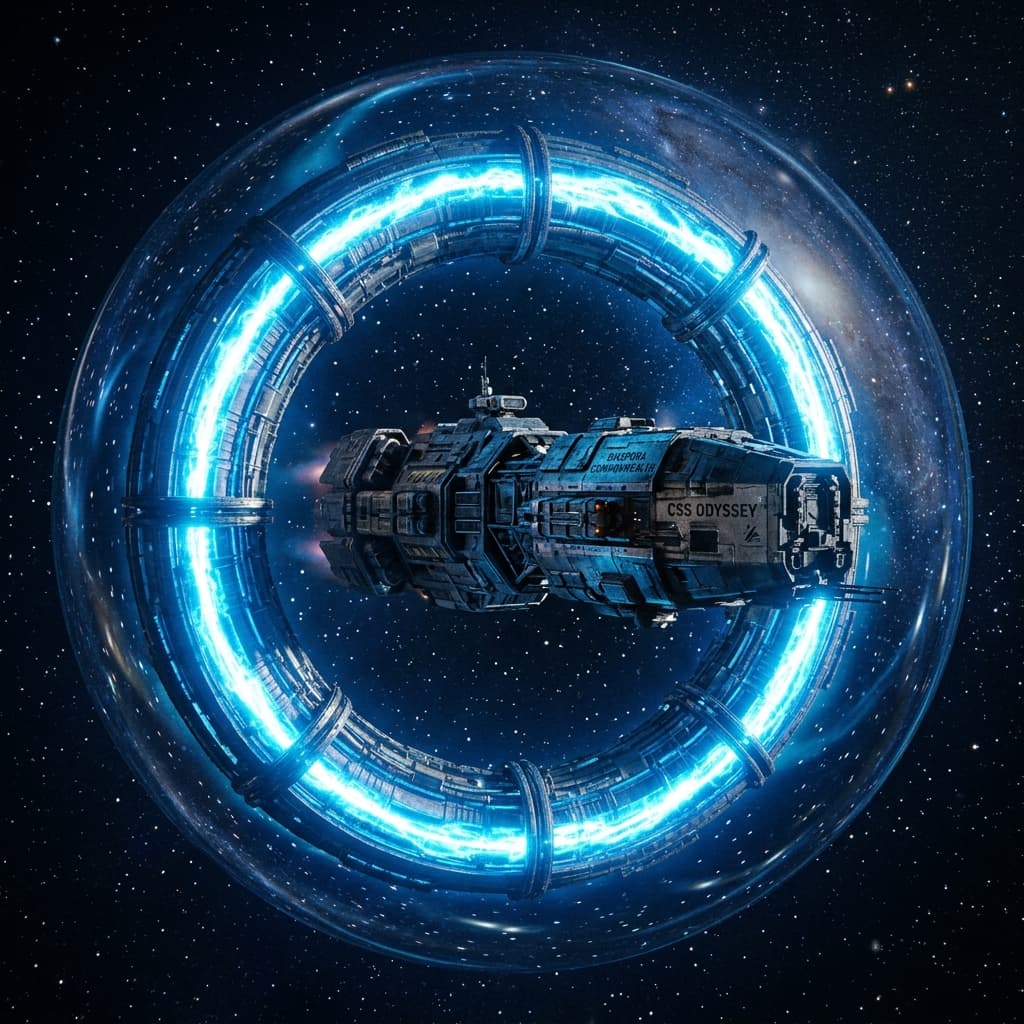
The Alcubierre-type warp drive enables faster-than-light travel by manipulating spacetime geometry—contracting space ahead of a vessel while expanding it behind, creating a 'warp bubble' that carries the ship without violating relativity. The ship doesn't move faster than light through space; rather, space itself moves around it.
Early warp drives achieved this using Casimir effect quantum vacuum energy, producing microscopic amounts of negative energy density. While revolutionary, these systems were catastrophically unstable, killing thousands and earning the 2307-2638 period its grim moniker: 'The Dark Age of FTL.'
The discovery of Interstitial Matter Type-9 (IM-9) in 2638 CE and its integration into warp systems by 2650 CE represented a civilization-defining breakthrough. Modern IM-9-based warp drives are 100x more stable, 10x faster, and can sustain travel for weeks instead of hours. This transformation enabled true interstellar civilization and Commonwealth expansion.
II. Fundamental Principles
A. Alcubierre Metric Spacetime Manipulation
The Alcubierre warp drive creates a localized distortion of spacetime that allows a vessel to travel faster than light without violating general relativity. The ship remains in a 'flat' region of spacetime (the bubble interior) while the bubble itself moves through space at superluminal velocities.
Spacetime Geometry details: • Forward Region: Space contracts, reducing distance to destination. • Aft Region: Space expands, increasing distance from origin. • Bubble Interior: Flat spacetime; crew experiences no acceleration or time dilation. • Bubble Boundary: Sharp spacetime gradient where curvature transitions.
The Alcubierre metric modifies Einstein's field equations to create a region of negative energy density surrounding the vessel. This 'exotic matter' field generates the necessary spacetime curvature without requiring the ship to accelerate to relativistic velocities.
B. Energy-Matter-Spacetime Relationship & Bubble Dynamics
The amount of spacetime curvature achievable depends directly on the quantity and stability of negative energy density, the precision of the field geometry configuration, and the power available to sustain the field against quantum decoherence.
Warp bubble 'thickness' determines its stability (thicker = more stable). The toroidal shape distributes stress more efficiently than a flat ring. The bubble must be actively maintained; passive collapse is inevitable.
C. Velocity and Range Characteristics
Warp drives do not accelerate ships through space—they move space around ships. Effective velocity depends on the rate of space contraction/expansion and bubble stability limits.
Range limitations: Pre-IM-9 was limited to single light-years per jump, whereas modern IM-9 drives allow hundreds of light-years of continuous travel.
Unlike relativistic travel, warp bubble occupants experience proper time matching the origin and destination reference frames. This 'frame locking' is inherent to the Alcubierre geometry.
D. Warp Factor Scale Calibration
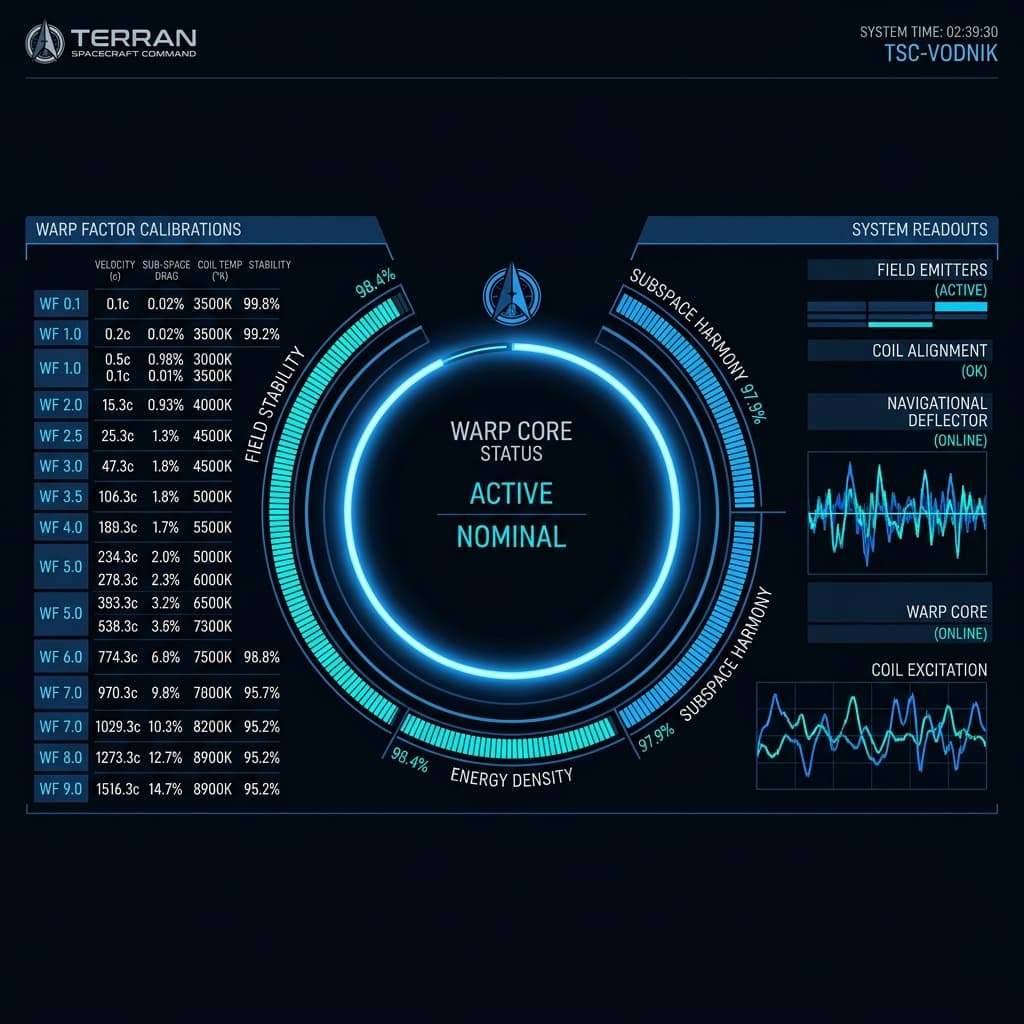
The Terran Warp Factor (WF) scale is the standardized operational convention governing FTL speed calibration, fleet navigation orders, engineering thresholds, and commercial traffic throughout the UTC. All modern IM-9 warp drives are rated and operated against this scale.
Operating Conventions: • Whole Factors — Default for fleet commands, navigation logs, and civilian travel. 'Warp 5' or 'Warp 7' are the understood standard for nominal cruise orders. • Half-Steps (e.g., Warp 5.5, Warp 7.5) — Acceptable in military and emergency contexts. Used when precise velocity control is operationally necessary — intercepts, pursuit, evasive maneuvers. • Decimals Beyond Halves (e.g., Warp 7.25) — Strictly reserved for engineering logs and fine calibration.
214.0c
III. The Dawn of Warp (2250s–2307 CE)
Discovery and manipulation of gravitons in the 2080s-2130s CE enabled first experiments in controlled spacetime curvature. Casimir effect studies in the 2150s-2200s CE revealed the existence of negative energy density at microscopic scales, laying the groundwork for 'Practical Applications of Negative Energy Spacetime Engineering' by Dr. Sarah Vekara in 2248 CE.
Experimental development occurred in three phases: Phase I (Static Field Generation, 2250s-2270s CE) which saw 47 researcher casualties; Phase II (Dynamic Bubble Formation, 2270s-2285 CE) featuring the 'Vanishing' of probe Echo-7 and 89 casualties; and Phase III (Manned System Integration, 2285-2307 CE) with 156 casualties.
The first operational drive was achieved in 2307 CE by the TNS Horizon, commanded by Captain Elena Vasquez. The ship completed a historic voyage to Proxima Centauri and back in 5.4 days of subjective warp duration.
"We have returned. The stars are no longer beyond our reach. I have seen Proxima's light from orbit and walked beneath an alien sun. The journey was… difficult. The ship groaned in ways I've never heard metal groan. We lost containment twice and had to drop from warp. The field fluctuations made half the crew violently ill. But we made it. Humanity is no longer bound to Sol. Whatever comes next, we proved it can be done."
IV. The Dark Age of FTL (2307–2638 CE)
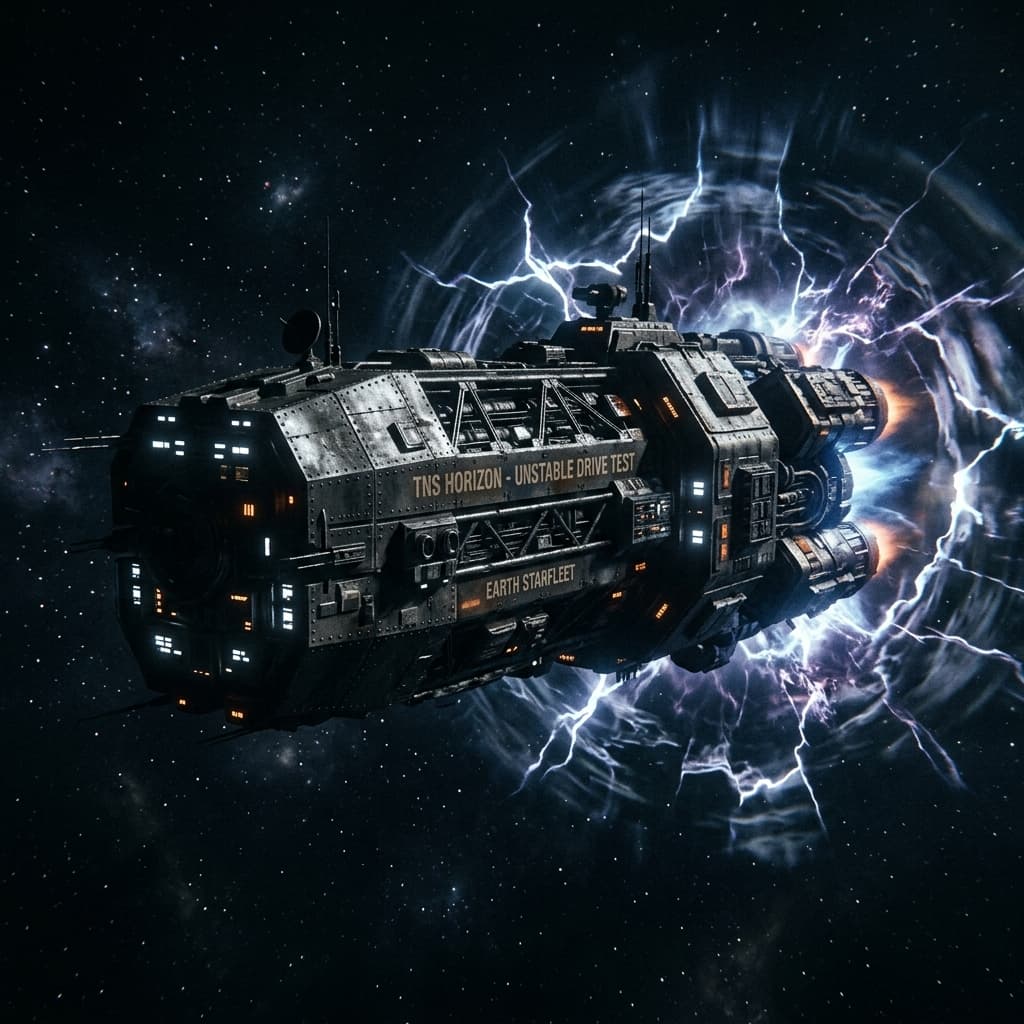
"Count the stars, say your prayers, hope your bubble holds the air"
Casimir-based warp drives were not ready for mass deployment, resulting in 331 years of dangerous FTL travel. Across all flights, there was a ~40% mission failure rate, with over 2,000 vessels lost ('ghost ships') and 50,000 to 80,000 casualties.
Technical limitations included: Catastrophic Instability (unpredictable mid-transit bubble collapse with zero warning), Severe Range Restrictions (maximum continuous operation of 12-18 hours and mandatory 48-72 hour cooldowns), Extreme Energy Requirements (bootstrapping required a Zero-Point Initiation Core petajoule-scale surge), Navigational Hazards (the 'blind jump' problem where sensors were useless), and Crew Health Effects ('warp sickness' and profound existential dread).
V. The IM-9 Breakthrough (2638–2700 CE)
The Standing Wave Lab Incident in 2638 CE accidentally discovered Interstitial Matter Type-9, providing industrial quantities of stable negative energy with consistent properties. This enabled the development of the first IM-9 vessel, TNS Revolution, in 2647 CE, which flew to Epsilon Eridani and back with zero equipment failures.
A rapid conversion program followed: all government vessels were retrofitted by 2665 CE, and civilian fleets by 2678 CE. Failure rates plummeted from 22% to less than 1%, average speeds tripled, and range expanded ten-fold.
Modern IM-9 civilian drives feature a toroidal containment ring holding 5-50 kg of IM-9, multi-axis field emitters, matter-antimatter sustaining reactors, zero-point bootstrapping cores, and null field dampeners.
"I've flown warp drives for thirty years. I've lost friends to bubble collapse. I've watched good ships die screaming as spacetime tore them apart. Today, I flew the Revolution to Epsilon Eridani and back, and I felt... safe. The old drives fought you every second. This one just works. It's smooth. It's stable. It's like the difference between riding a wild animal and piloting a precision instrument. This is what warp drives should have been from the beginning."
• **Emitters**: Multi-axis real-time harmonic adjusters
• **Failsafes**: Quad-redundant field collapse links
• **Dampening**: Triple null field quantum suppressors
• **Warp Sprint**: Instantaneous bubble deployment
• **Signature**: Electromagnetic & gravimetric suppression
• **Sustainability**: Sustained sprint up to 7–10 days
Military Operations & Siphon Allocation
Military configurations employ 80-200 kg of IM-9, enabling maximum speeds of 500-800c, combat maneuvering, and signature minimization. This consumes massive quantities of exotic matter, requiring approximately 800,000 kg of IM-9 annually for the Navy.
This creates a profound vulnerability: the entire Commonwealth is dependent on two siphons (Kordahl and Myrral). Loss of these siphons would ground the FTL fleet within months, causing civilization-scale fragmentation.
VI. CURRENT TECHNOLOGY STATUS (2950 CE)
Modern warp drives represent three centuries of refinement. Generation 4.5 civilian drives sustain 300c, while Generation 4.8 military systems reach 800c. Experimental Generation 5.0 drives explore hybrid Terran-Pelari designs targeting speeds over 1500c.
Today, over 70,000 warp-capable vessels conduct millions of warp jumps annually. Interstellar trade, tourism, exploration, and military operations depend entirely on this technology, consuming approximately 4.3 million kg of IM-9 per year.
VI. Cross-Species Perspectives
Terran philosophy treats warp drive as both a crowning achievement and an existential vulnerability due to absolute dependency on IM-9 siphons.
The Pelari reject industrial extraction, instead using Phase-Tide navigation to ride natural IM-9 resonance currents at 10-50c speeds.
The Chorus view warp drives as crude mechanical manipulation of forces they interact with biologically.
The Vorokh operate mysterious Rift Drives at hazardous speeds approximating or exceeding Warp 9, ignoring safe operational ceilings.
**Posture**: Control over metric, numeric grids, CO sprints, and formal clearance tiers.
**Posture**: Rejects extraction; navigates "swift hymn speeds" harmonized with ambient fields.
**Posture**: Sees mechanics as crude; navigates via partially-phased biological adaptation.
**Posture**: Runs at redline sprint limits (exceeding WF 9) with high tolerance for instability.
VII. Regulatory & Treaty Framework
• **Gravity Wells**: Warp initiation strictly prohibited within stellar system boundaries.
• **Flight Plans**: Mandatory registry filings prior to any FTL jump sequence.
• **Safety Links**: Mandatory automated dead-man bubble collapse switches.
• **Tri-Species Addendum (2865 CE)**: Extended oversight to Chorus and Pelari inspectors.
• **FTL Navigation Treaty (2720 CE)**: Standardized safety lanes, routes, and emergency beacons.
Near-term priorities include incremental efficiency gains, while mid-term goals focus on Generation 5.0 hybrid drives and alternative negative energy sources. Speculative concepts under study include warp network highways and fixed warp gates.
Warp drive technology transformed humanity from a single-planet species into an interstellar civilization. The 331 years of the Dark Age shaped Commonwealth culture, creating deep reverence for early pioneers and appreciation for modern safety.
The IM-9 breakthrough was civilization-defining. While the dependency on two siphons remains an existential risk, the benefits of interstellar unity and peaceful coexistence with the Pelari and Chorus justify the calculation. The stars have become home.